Temple University Athletics
10.23.26 | Football
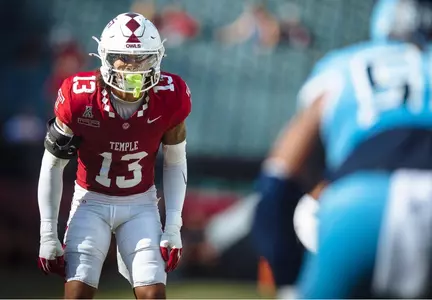
While Denzel Chavis brings plenty of energy and personality to the Temple Owls Football team, he understands that leadership goes beyond what he says. For him, it's just as much about his own habits and making sure that he's setting the right example.
It's an approach that extends well beyond the football field, shaped by a childhood in northern New Jersey, the sacrifices of his mother and the responsibility that came with becoming an older brother.
While he briefly lived in Delaware, Chavis spent much of his childhood in West New York and North Bergen, New Jersey. He was raised primarily by his mother and grandmother, alongside his siblings, in a household where hard work and sacrifice were part of everyday life.
His mother worked two jobs to support the family, which often involved early mornings and returning home late. Some nights, Chavis and his brother would stay downstairs with their aunt because they were too young to be home alone while their mother worked.
At the time, he didn't fully understand the sacrifices she was making. Looking back, however, those experiences have become some of the most important lessons he carries with him.
"That's the stuff at the time, you don't really see as a kid," Chavis said. "You don't really get to appreciate until you're older, that your mom was making all these sacrifices just to, you know, give you lunch money every day and get you new shoes for the school year."
Watching his mother work to provide for her children without making excuses taught Chavis the importance of sacrifice and perseverance, two qualities that continue to influence his approach to football and life.
While football has become a significant part of Chavis' life, it wasn't the first sport he picked up.
He began playing T-ball while living in Delaware and continued playing baseball after moving back to New Jersey. Basketball followed, but it wasn't until the third grade that he was introduced to football.
On the first day of school that year, Chavis' father struck up a conversation with another parent whose son played football. The parent suggested bringing Chavis out to practice, and he decided to give it a try.
He was placed in the backfield as a running back, and what started as an unexpected introduction soon became his primary sport.
By fifth or sixth grade, his parents encouraged him to choose one sport so he could focus more on school. Chavis was already finding the most success in football, making that decision relatively easy.
"I was the best at football, so it was kind of like a non-negotiable," Chavis said. "And I enjoyed it more than playing basketball and baseball anyways."
Although he started as a running back and linebacker, Chavis eventually transitioned to cornerback during his later years of Pop Warner football. As other players grew bigger, he began recognizing that his future might be better suited to the secondary.
The transition gave him a new position to study and a new set of players to model his game after. By his sophomore year of high school, he began taking the position more seriously, working with a defensive backs coach who also trained Division I and NFL players.
Working with the coach helped Chavis sharpen his skills and continue developing as a defensive back. At Union City High School, he also demonstrated his versatility, playing cornerback, quarterback, running back and wide receiver. He earned first-team All-Super Football Conference honors as a junior and senior, along with all-state recognition in his final season.
But football wasn't the only thing that would connect Chavis' years in North Jersey to his eventual arrival at Temple.
Chavis met fellow Temple defensive back Adrian Laing in middle school, and the two quickly became close friends. Although they attended different high schools, with Chavis at Union City and Laing at Paramus Catholic, both continued pursuing football careers that would eventually bring them to Temple as members of the 2024 recruiting class.
"It's like having somebody that's just like you all the time," Laing said. "You just hang out 24/7."
Despite their friendship, the two never planned to attend the same college. However, Laing would end up playing an unexpected role in Chavis' recruitment to Temple.
Chavis first visited Temple during his junior year of high school, but the program had not yet hired a cornerbacks coach. Rather than extending an offer without a position coach in place, the staff encouraged him to return for another visit.
As the recruiting process continued, Chavis nearly forgot about the opportunity.
That changed when Laing received an offer from Temple.
Seeing his friend's offer reminded Chavis that he had been invited back, prompting him to arrange another visit. Even then, he began to feel worn down by the recruiting process and considered skipping the trip.
His father encouraged him to follow through.
"My dad was like, 'Nah, just for me, just thug it out, and then we'll see where it goes after,'" Chavis recalled.
He returned to campus where cornerbacks coach, Dominique Bowman, extended an offer.
"If I hadn't seen Adrian get the offer, I probably would have forgotten to come back here," Chavis said.
From there, Chavis continued building a relationship with Temple's coaching staff. He was drawn to the family-oriented environment the program emphasized, frequently returning to campus during the spring of his senior year to attend practices and spend time around the team.
Still, he and Laing never discussed making their college decisions together.
They understood that each might be looking for something different in a school, whether that meant the environment, culture or opportunities available.
When both ultimately committed to Temple, it came as a surprise.
"We weren't even supposed to come to the same school," Laing said. "It just happened like that. We didn't talk about it or anything."
Now teammates at Temple, the two have maintained the same energy that defined their friendship growing up.
Laing believes their personalities stand out, even in a position group filled with energetic players. But beyond that energy, he sees something more important in Chavis.
"My favorite thing about Denzel would be his ability to hold people accountable to what they say," Laing said.
That accountability has become an important part of Chavis' role within the Temple program.
After redshirting in 2024, Chavis appeared in every game during the 2025 season, earning his first career start against East Carolina. He entered the 2026 season as a starting cornerback, taking on a larger role in the Owls' secondary.
As a returning player and starter on a roster featuring plenty of new faces, Chavis has found himself in a position where teammates look to him for guidance.
He doesn't necessarily see leadership as something that requires constant talking. Instead, he focuses on his own habits and making sure he's setting the right example.
"I'm just always trying to do the right things," Chavis said. "If anybody's looking at me, I'm just trying to continuously do the right things."
That mentality has also shaped how he approaches relationships with his teammates. However, he also recognizes that accountability only works when teammates are willing to accept criticism from one another.
"Just letting go of all the egos," Chavis said. "We all go out there for one goal."
For Chavis, that means understanding that criticism from a teammate isn't necessarily personal. It's part of working toward something bigger than any individual player.
He believes those relationships will continue developing as the team grows more comfortable together.
It's a perspective that closely mirrors the responsibility Chavis has learned to embrace within his own family.
Once the youngest among his brothers, Chavis eventually became an older brother himself with the arrival of his younger brother and sister. The change forced him to think more carefully about the example he was setting.
He understood that his younger siblings would watch his actions and use them to help determine what was right and wrong.
"Just adjusting and just learning how to be a role model," Chavis said. "Just understanding that, you know, they are gonna look up to you, and the things you do, and to see what's okay and not okay."
Being away at Temple hasn't changed the importance of those relationships.
Chavis makes an effort to stay connected with his younger siblings, checking in on them and making sure they know they can turn to him for advice.
He describes his younger sister as his "little twin," and he hopes to be the kind of older brother his siblings can rely on as they grow up.
Having looked up to his own older brothers, Chavis understands what that relationship can mean.
"I always wanted to be next to my older brothers," he said. "So I just want to be that brother for them."
That desire to help others is something Laing sees in Chavis beyond the football field, too.
While he joked that Chavis is "smarter than he looks," Laing was quick to point out his friend's intelligence and interest in a potential future in coaching.
"He's very intelligent," Laing said. "He knows a lot. He's very into his books, and that kinda shows what he's going to be coaching-wise in the future. He's gonna be a good coach."
Whether that future eventually takes him into coaching remains to be seen, but the qualities Laing identifies are already present in the way Chavis approaches his role at Temple.
For a player whose earliest lessons in sacrifice came from watching his mother work to support their family, those responsibilities aren't something he takes lightly.
And while his role on the field may continue to evolve, the example he wants to set remains much the same: work hard, do the right things, and make sure the people around him are better for it.