Temple University Athletics
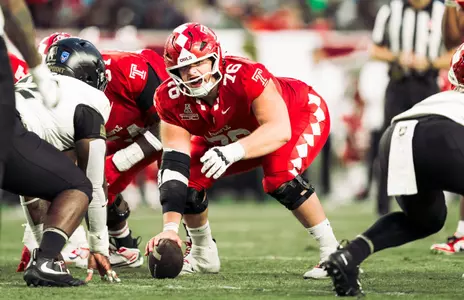
John Stone’s Strength Goes Beyond the Football Field
10.9.26 | Football
Ask Temple quarterback Ajani Sheppard what he likes most about his center and close friend, John Stone, and his answer comes quickly.
"His violence."
It is an interesting choice of words when describing someone who, away from football, seems to operate almost entirely on the other end of the spectrum.
Stone waves at people. He gives out high fives and handshakes. He talks about the importance of listening, and he also worries that people have forgotten how to simply be human.
On the football field, that changes.
"My father always told me about being able to flip the switch on and off," Stone said. "You can't just be a violent person out on the field and then be a not-good person off the field. You have to be able to do it all."
Stone has carried that with him from Sewell, New Jersey, to Rutgers and now Temple, where he is finally getting the opportunity he spent three years waiting for.
His teammates have seen both sides.
Sheppard affectionately calls him a "meathead" and a "dog," describing someone he considers a brother and trusts to give everything he has on every snap. Sam Brown points to Stone's work ethic and mindset, saying no moment seems too big for him.
"He's always just trying to get out there and protect the play," Brown said.
But the intensity that his teammates admire on game days and in practice is only one part of who Stone is. Away from football, the compassion, love, and respect he shows others are values his family instilled in him from an early age.
The oldest of four children, he spent the first seven years of his life as an only child before becoming an older brother to two boys and a younger sister. His siblings mean the world to him, particularly his youngest sister.
"She's my baby sister. She's my world," Stone said.
His parents, and particularly his father, shaped much of how he approaches the people around him.
Stone watched his father pass up opportunities to make more money so he could spend more time with his children. He coached them, supported them, and tried to make sure they grew into good people along the way.
Now, Stone tries to do the same for his younger siblings.
"I'm just trying to show them the way and be a good example for them," Stone said.
His grandparents were a major part of that upbringing, too.
Stone remembers his grandmother and grandfather constantly cooking for him growing up. He jokes that the two deserve some credit for him becoming as big as he is today. Losing both grandparents in the same year was difficult, but his parents encouraged him to use the loss as motivation.
Through all of it, his family remained what Stone calls his backbone. It also became one of the biggest reasons Temple felt right.
Rutgers had kept the New Jersey native relatively close to home. Temple put him even closer.
After three years at Rutgers without the playing time he had hoped for, Stone entered the transfer portal looking for another opportunity. He visited multiple schools, but Temple put him about 25 minutes away from his family.
When he made his first career start, 14 of his closest family and friends were there to support him.
"I can go home for a home-cooked meal every now and again," Stone said. "I mean, you can't beat it."
Still, being close to home was only part of it. Temple head coach K.C. Keeler had coached Stone's uncle, Michael Garcia, at Rowan. Stone also already knew Temple running back coach Andrew "A.P." Pierce from Pierce's time recruiting him at Delaware.
Then there was Cole Fitzgerald.
Fitzgerald, a former Temple student equipment manager, battled cancer before passing away while Stone was at Rutgers. Stone calls him one of his "whys" and still wears a shirt honoring him before games.
After committing to Temple, Stone went home and happened to run into Fitzgerald's parents at his local CVS. For Stone, it was another connection that made his decision feel like it had been leading somewhere.
"I feel like a lot of things have come full circle in this moment," Stone said.
That feeling only grew when some familiar faces followed him.
Stone was the first of a group of Rutgers players to decide on Temple. He encouraged Brown and Zach Aamland to make the move, while Sheppard, one of his closest friends in college football, eventually joined him.
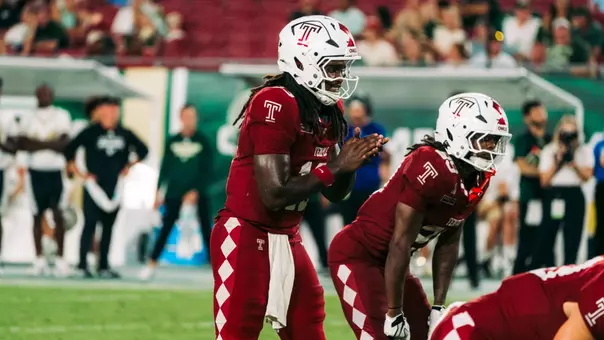
Stone and Sheppard already had thousands of repetitions together.
Stone had never played center before arriving at Rutgers, and learning to snap did not come easily. Sheppard would join him for early-morning work and stay late at the team's practice facility, known as the bubble, until Stone got it right.
Over two seasons, Stone estimates they took thousands of snaps together.
By the time they reunited at Temple, they did not have to rebuild that chemistry. Stone already knew how Sheppard liked his snaps and how he operated at quarterback.
They knew how to push each other, too.
"There's no ego between it, 'cause we know, at the end of the day, it's because we have this immense amount of love for each other," Sheppard said. "The only thing we want to see is each other succeed."
For Stone, finally getting his own opportunity to succeed had taken time.
Football has been part of his life since he was four years old. At Rutgers, he kept putting everything he had into the game while waiting for an opportunity to get on the field.
Eventually, that wore on him.
"I'm somebody that gives it my all and grinds and puts all 100%," Stone said. "It was tough, taking a seat for three years on the bench."
Stone said he fell into "a little bit of a dark place." Football had been part of nearly his entire life, and after three years of waiting, he was still looking for the opportunity to show what he could do.
Temple offered him a fresh start, closer to the people who had supported him through it all.
Now, he is not only playing center. He is being asked to lead from that position.
Stone credits Grayson Mains and Jackson Pruitt with helping him learn Temple's system when he arrived. Early on, he tried to listen more than he spoke. As he became more comfortable, he started using his voice more.
Playing center requires it. Stone is responsible for directing traffic and making calls at the line, all while trusting the other four offensive linemen around him and asking them to trust him back.
He considers that a privilege.
"When you listen to people, the better you understand people, the more you're able to communicate," Stone said.
There are still parts of his game he is working on, and even with their chemistry, Sheppard sees room for growth. He believes Stone can continue learning to manage his emotions in a sport that demands so much intensity.
"Football's an emotional game," Sheppard said. "As we get more reps, as we get more experience, it'll just get better and better."
The intensity is not going anywhere. Neither, Stone hopes, is the person he becomes when he walks off the field.
"My dad always preached to me, treat others how you want to be treated," Stone said. "A wave, a high five, a handshake; it can go a long way in life."
For Stone, it is not something he has to think much about. It is just how he was raised.
His goals are not much different. He wants to accomplish something at Temple. He wants a chance to play in the NFL. But when Stone talks about what he actually wants from his future, football does not come first.
His family does.
"My goal is to just have my family be successful," Stone said. "Just the people around me, I want everybody to succeed. I want to be able to take care of my family later in life."
For a center whose closest friends admire his violence on the field, Stone's vision for the future has little to do with football.
"Just live a happy life," he said. "That's it."