Temple University Athletics
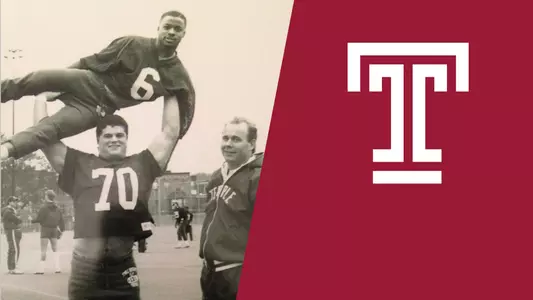
Rienstra, Paul Palmer and Bruce Arians
11.6.26 | Football
The first thing Paul Palmer noticed about John Rienstra was his size. The second was how quickly he could move.
With his broad shoulders, enormous arms and distinctive wardrobe of sleeveless flannel shirts and work boots, Rienstra was an imposing figure even among the football players who surrounded him. But during one of Palmer's first training camps at Temple, the young running back watched the offensive lineman participate in a conditioning test and discovered something even more remarkable about his future teammate.
Despite weighing considerably more than most of the players around him, Rienstra had little trouble keeping pace.
"I'd never seen anyone that big really move that fast," Palmer recalled. "I had never seen anyone in person that big, who moved that fast, and was that agile."
It was an early glimpse of the unusual combination of strength, speed and athleticism that would eventually make Rienstra one of the most accomplished offensive linemen in Temple football history.
In 1985, he became the first player in program history to earn Associated Press first-team All-America honors, establishing himself among the nation's premier offensive linemen before the Pittsburgh Steelers selected him ninth overall in the 1986 NFL Draft.
Yet for Palmer, the physical presence that made Rienstra so memorable was only part of the impression he left.
Despite his intimidating appearance, Rienstra was remarkably soft-spoken. Palmer struggles to remember hearing him raise his voice during their years together, even as the lineman developed a reputation for overpowering opponents on the field.
"He was intimidating when you first met him," Palmer said. "But then, when he spoke, it was disarming. He had a very soft-sounding voice."
The contrast was characteristic of Rienstra, whose quiet confidence and dedication helped define his approach to football. Although his accomplishments would eventually place him among the most recognizable players of his era, the journey that brought him to Temple was far from conventional.
Originally born in Michigan, Rienstra spent much of his childhood in Colorado before moving to the Philadelphia area for high school where he attended the Academy of the New Church, competing in both football and wrestling. By his own admission, wrestling was probably his stronger sport, and when his high school career ended, he had already made plans to attend Lehigh University to continue competing in both.
Those plans changed following a strong performance in a regional all-star football game, where he caught the attention of a Temple assistant coach.
With only weeks remaining before the beginning of training camp, Rienstra was invited to meet with then-head coach Wayne Hardin.
He remembers sitting in Hardin's office as the coach casually pantomimed swinging a golf club and asked about his plans for college. When Rienstra explained that he intended to attend Lehigh, Hardin questioned how he planned to afford the university's tuition.
Rienstra told him that his father had promised to figure something out. Hardin offered another possibility: a scholarship to Temple.
Within weeks, Rienstra found himself preparing for the most demanding training camp he had ever experienced.
"I competed at a very small high school, and then six weeks later, there's over 100 guys out there, and some are already 23 years old," Rienstra recalled. "I was in the toughest camp of my life."
The adjustment to Division I football was considerable. At approximately 225 pounds, Rienstra was much smaller than the player he would eventually become, and he readily acknowledges that he wasn't yet prepared for the caliber of competition Temple regularly faced.
What he lacked in experience, however, he made up for in dedication and enthusiasm.
Older teammates nicknamed him a "wind-up doll" because of his seemingly endless energy during practices and conditioning drills. Even after exhausting days on the field, Rienstra often found himself exploring Philadelphia while his teammates rested, fascinated by the city's buildings, subway system and unfamiliar surroundings.
For a young athlete who had arrived at Temple almost by chance, the experience was overwhelming in more ways than one.
But as he began to adjust to college football, Rienstra recognized that his passion alone would not be enough to succeed at the highest level. If he wanted to compete against the players Temple regularly faced, he would need to become considerably stronger.
Following his freshman season, he elected to redshirt and joined the university's powerlifting team, immersing himself in a sport that would fundamentally change his development.
He trained alongside accomplished competitors, studied proper lifting techniques and began eating as many as six meals a day to support his physical growth. By the end of his redshirt season, he had increased his weight to approximately 255 pounds without sacrificing the mobility that distinguished him from other linemen.
The transformation was not simply physical.
Rienstra developed a close relationship with his strength coach, Lincoln Gotshalk, who taught him to approach lifting as a mental exercise as much as a test of physical ability.
"He taught me how to lift with your mind, and then your body's just results," Rienstra said.
The philosophy resonated with him. Rather than approaching a difficult lift as something his body might or might not be capable of accomplishing, he learned to concentrate on the movement, visualize its execution, and commit himself fully to the attempt.
The relationship extended well beyond the weight room. Gotshalk eventually served as the best man at Rienstra's wedding, a testament to the importance of the people who helped guide him through his years at Temple.
Powerlifting would remain an important part of Rienstra's athletic identity. In 1986, he captured the national collegiate super-heavyweight powerlifting championship, adding another distinction to a resume already filled with football accomplishments.
By then, however, his transformation had also helped reshape his role within Temple's football program.
When Bruce Arians took over as head coach, he was determined to establish a more demanding competitive culture and find ways to maximize the talent already on the roster.
One of his decisions was to move Rienstra from defensive end to offensive guard.
Arians believed his best athletes needed to be on the field, regardless of the positions they had previously played. Rienstra's increasing strength, combined with his exceptional speed and coordination, made him an ideal candidate for the offensive line.
By the beginning of his sophomore season, he had earned the starting job at left guard.
"Oh gosh, he took it to another level," Arians recalled. "He was just a skinny defensive end when he came in and got into powerlifting and just became one of the best all-around football players in the country."
Rienstra's physical development continued, eventually bringing him close to 290 pounds. Even at that size, Arians remembers watching him perform backflips, an extraordinary display of athleticism for a player whose primary responsibility was battling defensive linemen.
It was that versatility that made him particularly valuable to Temple's offense.
Rienstra could overpower defenders directly in front of him, but he was equally capable of pulling across the formation, reaching the second level and creating opportunities for running backs in open space.
For Palmer, who arrived at Temple as a relatively undersized freshman, having someone with those abilities blocking ahead of him provided an immediate sense of security.
"When you go out on the field and you're a back and you have a guy in front of you like John was, you feel a certain sense of security on the field," Palmer said.
The two would develop one of the most productive partnerships in Temple's offense during the mid-1980s, with Rienstra's versatility allowing Palmer to take advantage of opportunities that might otherwise have been difficult to create.
"John was great on screens because he's so fast," Palmer said. "John was great on sweeps because he's so fast. And then John would be just the same straight ahead because he was so strong and so powerful and so explosive."
Over time, their understanding of one another became almost instinctive.
Rienstra remembers executing trap blocks with Palmer following closely behind, often running just off his hip as the offensive lineman worked to create an opening.
"I trapped a lot, and Paul would be right behind me on my hip," Rienstra said. "He had confidence in me, and I had confidence in him."
For Palmer, that trust allowed him to make decisions without hesitation. He knew Rienstra would be in position, and the lineman understood how Palmer was likely to respond to the developing play.
Their partnership was also supported by an experienced offensive line whose members had spent years learning to work together.
Rienstra is quick to recognize his teammates' contributions, emphasizing that their collective understanding and willingness to execute their assignments were essential to the offense's success.
It is a perspective that has remained consistent throughout his career. Even when discussing his own accomplishments, Rienstra frequently returns to the people who helped make them possible.
Palmer sees their relationship in much the same way.
"I think John and I kind of scratched each other's backs," Palmer said. "I'm partially responsible for the recognition that John has gotten, and without a doubt, John is partially responsible for the things that I've received and the recognition that I receive."
Palmer would eventually finish as the runner-up for the 1986 Heisman Trophy, becoming one of the most celebrated players in Temple history. He stands as the only Temple player in the College Football Hall of Fame and hopes to one day have Rienstra join him. Ironically, Palmer's selection was delayed as many voters thought he had already been inducted, and Rienstra delay to be placed on the ballot may be for the same reason or perhaps due to the fact that many current voters were too young to see Rienstra's accomplishments first hand.
Their success also reflected the broader transformation taking place within Temple's program under Arians at that time.
Throughout the early and mid-1980s, the Owls regularly faced some of the most demanding schedules in college football, competing against nationally prominent programs whose rosters included future NFL stars.
Rienstra remembers lining up against opponents featuring Herschel Walker, Doug Flutie and Dan Marino, as well as facing Penn State teams led by Todd Blackledge.
For a program that rarely entered those matchups as the favorite, the opportunity to compete against nationally recognized opponents was both a challenge and a source of motivation.
"We would play anybody," Palmer said. "It didn't matter who we played. We weren't intimidated."
The attitude reflected the resilience and determination that would become synonymous with Temple TUFF.
Arians expected his players to compete physically with anyone, regardless of the opponent's reputation. The Owls did not always emerge victorious, but they frequently challenged teams that were expected to overpower them.
Some of Rienstra's most vivid memories come from those narrow defeats.
He recalls a matchup against Penn State in front of more than 100,000 spectators, when Palmer rushed for more than 200 yards and Temple pushed one of the nation's premier programs to the final moments.
"We were physical, we physically beat them up," Rienstra recalled. "We were so close."
Arians remembers the frustration of those games just as clearly, particularly a stretch in which the Owls faced BYU, Penn State and Boston College in succession.
"I think we lost all three games by a total of seven or eight points and had a chance to win them all," Arians recalled.
For Rienstra, the competitiveness of those matchups demonstrated what Temple was capable of accomplishing. The Owls were not simply measuring themselves against more established programs; they were challenging the expectations surrounding their own.
His individual athleticism occasionally allowed Arians to employ him in unexpected ways.
During a matchup with BYU, the coach temporarily returned his standout offensive guard to the defensive side of the football, asking him to line up at nose tackle against quarterback Robbie Bosco.
The play did not initially unfold in Rienstra's favor.
After engaging the offensive line, he was knocked to the ground by a combination of blockers. Rather than remaining down, Rienstra scrambled forward on his hands and knees, spotted Bosco's legs and reached out to bring the quarterback down for a sack.
"I just darted out of there on all fours," Rienstra recalled. "All I saw was Robbie Bosco's legs in front of me, and I just swiped them, and he went down."
Arians still remembers the play decades later, citing it as an example of the athleticism that made Rienstra so valuable.
His ability to contribute on both sides of the football reflected the versatility that had originally prompted the coach to move him to guard, but by that point, his accomplishments on the offensive line had already begun attracting national attention.
In 1985, Rienstra became Temple's first Associated Press first-team All-American and was named one of nine finalists for the Outland Trophy, presented annually to the nation's top interior lineman.
The recognition placed him among college football's elite, an extraordinary achievement for someone who had arrived at Temple as a relatively inexperienced defensive player only a few years earlier.
For Arians, Rienstra's success carried implications far beyond individual recognition.
"To see him on the Bob Hope show as an All-American in that Temple uniform, it changed a lot of things when we went out recruiting," Arians said.
His accomplishments demonstrated that Temple could develop players capable of competing with the best in the country, earning national recognition and pursuing professional opportunities.
Rienstra had become an example of what was possible within a program still working to establish itself against some of college football's most recognizable institutions.
Yet for all of his success, those who knew him best rarely describe him as someone particularly interested in drawing attention to himself.
"There was always a very quiet confidence about him," Palmer said.
Even when opponents attempted to provoke him, Rienstra rarely offered much of a response. His focus remained on executing his assignments, relying on preparation and physical ability rather than emotion to establish himself.
"He just went about his business as if it were business," Palmer said.
The same approach carried into the weight room, where Rienstra's dedication became a source of inspiration for his teammates.
Palmer remembers watching him train and understanding that his remarkable physical abilities were not simply the product of natural talent. They were the result of countless hours spent developing his body, refining his technique and pushing himself beyond what others might have considered possible.
"John is an example of it's not what's in the weight room, it's what you put in the weight room," Palmer said.
At a time when Temple's athletic facilities were far more limited than those available to players today, Rienstra demonstrated that dedication and discipline could help bridge the gap.
His example encouraged those around him to approach their own development with the same seriousness.
"He just worked so hard," Palmer said. "It inspired you to work hard because you knew there would always kind of be someone there along with you working hard."
That influence was not limited to football. For Rienstra, the relationships he developed at Temple became among the most meaningful parts of his college experience, shaped by the people who helped him grow and the teammates who shared those years with him.
He credits his parents, particularly his father's emphasis on education, along with Hardin, Arians and the strength coach who helped transform his understanding of physical training.
The friendships he developed with teammates were equally important.
Arians made a deliberate effort to bring his players closer together, arranging for members of the football team to live near one another in campus residence halls.
"Your buddy's right next door to you, if he's not your roommate," Rienstra said.
Living together helped the players develop relationships beyond the practice field, allowing them to build the familiarity and trust that would eventually carry into games.
The same philosophy extended to the team's travels.
Rienstra remembers a trip to Florida State when Arians arranged for the players to arrive early enough to explore the surrounding area, including a boat tour through the Florida wetlands.
For Rienstra, those experiences remain as vivid as many of the games themselves.
"I don't ever forget stuff like that," he said.
The memories offer a glimpse into what made his years at Temple so meaningful. Alongside the demanding practices, nationally ranked opponents and individual accomplishments were experiences that helped turn teammates into lifelong friends.
Arians, whose coaching career would eventually carry him to a Super Bowl championship with the Tampa Bay Buccaneers, considers those relationships among the most important accomplishments of his time at Temple.
"Relationships is what it's all about," Arians said. "Winning games is very important to keep your job, but the building of relationships ... was very, very important."
The connections formed during those years would endure long after the players had moved on from Temple.
For Rienstra, the next chapter began when the Pittsburgh Steelers selected him with the ninth overall pick in the 1986 NFL Draft.
The selection represented the culmination of a remarkable transformation, from a high school athlete preparing to attend Lehigh to one of the most highly regarded offensive line prospects in the country.
He went on to play professionally for Pittsburgh and later the Cleveland Browns, carrying the lessons of his collegiate experience into the NFL.
His accomplishments would also earn lasting recognition at Temple.
In 1997, Rienstra was inducted into the Temple Athletics Hall of Fame, honoring his contributions to the program and the distinction he had earned as one of its premier players.
The university also established the John Rienstra Little Extra Award, presented annually to a Temple football player, ensuring that his name would remain connected to the program long after his playing career ended.
But while those honors reflect his place in Temple football history, Rienstra's connection to the university has continued to evolve through the relationships he developed there.
Earlier this fall, he returned to Philadelphia alongside former teammates and coaches to celebrate Arians' induction into the Temple Athletics Hall of Fame.
The occasion brought together members of a generation that helped shape the identity of Temple football, many of whom had remained close despite the decades separating them from their playing days.
For Arians, seeing so many former players together was a reminder of what he considered the most meaningful part of his coaching career.
"Those guys, to see them that close to this day, we must have been doing something right," Arians said.
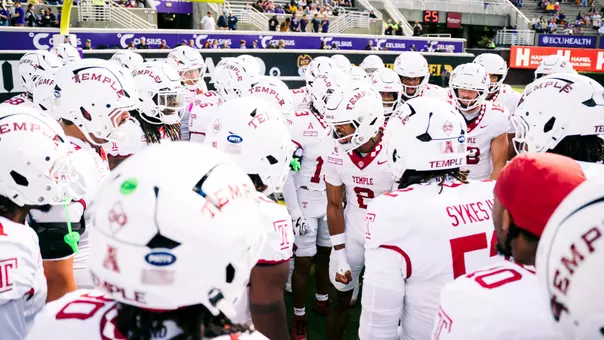
During his visit, Rienstra toured Temple's modern football facilities, reconnected with former teammates and addressed members of the current team.
The contrast between the facilities he remembered and those available to today's players was considerable. The weight room where he had once spent countless hours developing his strength had given way to a modern training environment with resources that would have been difficult to imagine during his playing days.
Rienstra was impressed by the changes, but the opportunity to reconnect with the program carried greater significance.
He remembers speaking to more than 100 players before Arians addressed the team, then spending the following day tailgating and watching the Owls from the sidelines alongside former teammate Tony Angeli.
"I loved that," Rienstra said of returning to the sidelines. "I'm really glad and happy I was invited and that I attended."
The experience brought him back to a place where he had arrived more than four decades earlier with little understanding of what his football career might become.
At the time, Rienstra was a relatively inexperienced athlete who had expected to attend a different university. Within several years, he had transformed himself into one of the nation's premier offensive linemen, helped elevate Temple's national profile and established a standard that would continue to be recognized long after his departure.
His place in program history is reflected in the honors that followed: first-team All-America recognition, an Outland Trophy finalist selection, a national collegiate powerlifting championship and a top 10 NFL draft selection.
But when Rienstra considers what he hopes people will remember about him, his answer has little to do with those accomplishments.
Instead, he thinks about the people he has encountered and whether he has been able to make a positive difference in their lives.
"I hope they know I'll do anything for them," Rienstra said. "It's not all about me."
He hopes instead that the people he has encountered might carry something meaningful from their time together, whether through a conversation, a shared experience or an example worth following.
"I'd like them to do maybe better at whatever they do because of something I do or something I say," he explained.
For someone whose career was defined by helping create opportunities for others, it is a fitting measure of success. Rienstra's accomplishments secured his place in Temple football history, but his influence has never been confined to the recognition he received or the games he played. It continues through the people who shared those experiences with him, and the generations who have followed in his footsteps.
Thursday, November 05
Thursday, November 05
Wednesday, November 04
Tuesday, November 03