Temple University Athletics
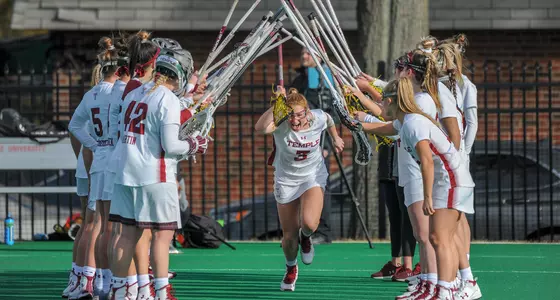
Photo by: Dave Fredman Frederick
Maddie Gebert Battles Opponents on the Field, and Epilepsy in Life
4.3.19 | Women's Lacrosse
The surprising and personal admission is easy to miss among the many reasons the Temple lacrosse student-athletes have chosen to support various organizations for "Cause Day." But a closer read reveals a diagnosis that junior Maddie Gebert has been living with throughout her college career – epilepsy.
The Owls' leading scorer is easy to spot despite her quickness on the field, with her bright red hair and ability to get to the cage. Off the field she is quick to smile and her easygoing attitude would never betray the struggles of having a neurological disorder.
Quick research on epilepsy reveals some staggering statistics about the disease, in particular, the fact that one in 26 people will develop epilepsy at some point in their lives. In the United States, 3.4 million people live with active epilepsy, and 150,000 new cases are diagnosed every year. Epilepsy means the same thing as "seizure disorders," and is a spectrum condition with a wide range of seizure types and control varying from person-to-person.
Gebert considers herself to be in the middle of that spectrum. After experiencing her first seizure as a freshman in high school, it seemed like a one-off because four years would pass until her next one. Since arriving at Temple as a freshman in 2016, Gebert has had a few major seizures and a couple less severe ones as well.
One of Gebert's more recent seizures gave her new freshmen teammates quite a scare, as it happened before a practice early in the school year.
"I got there early and got on the exercise bike, and the next thing I knew I was sick in the bathroom that's just outside the building," said Gebert. "I came into the locker room afterward where all my teammates were, only half conscious, and ended up passing out again. No one knew how long the seizure had been so I had to go to the hospital in case it had been more than a couple minutes. I black out and I really have no idea what happens."
To control her epilepsy, Gebert takes medication twice a day at 12-hour intervals. As an in-season student-athlete, she says her regimented schedule, at least when the Owls are at home, makes it easy to stay on track with her meds. On the road and during breaks from school, it can be much tougher.
"I can't go out and do everything I want," she says. "I can't stay up late to be social or do group projects. It isn't super-inconvenient for me, it just makes me conscious of keeping a regular routine and not doing anything crazy. When I travel it's hard to make sure I stay on top of the medication twice a day, and it can be harder to get the sleep I need but I really have to make an effort to do it."
Gebert had a seizure her sophomore year on a road trip to Butler the night before a game. She was adamant that she still wanted to play the next day and was cleared to do so by her doctor. She didn't start in the game, her only missed start in the past two years, but subbed in and later scored for the Owls.
"When Maddie has a seizure, everyone around her worries about her but she calms everyone else down and says 'I'm going to be ok, don't worry about it, I'll be fine tomorrow,'" said Temple head coach Bonnie Rosen. "Her parents are really supportive and recognize that this is just something she's dealing with and that she rebounds. I think about how hard it actually probably is on her, but she puts on a really positive, strong front and that's one of the things that makes her such a tough competitor on the field. But there's no doubt that she pays attention to how much sleep she's getting and how she's feeling, and at times it's both probably scary and certainly very inconvenient."
Gebert's seizures have been brought on in the past by lack of sleep and stress, but other factors could be triggers as well if she were to miss a dose of medication, such as drinking alcohol or flashing lights.
"All of my seizures have been after lack of sleep or stress from school," said Gebert. "My roommates can tell you I typically sleep at least eight hours a night. That's a huge thing. I also try to do papers early, to control stress and so I'll have them done in time in case I have a seizure, especially if we're on the road. My mom was initially worried that lacrosse would be too stressful, but my doctor encouraged it because working out is a really good thing for keeping epilepsy in check."
Gebert has juvenile myoclonic epilepsy (JME), which is usually genetic, but is not aware of any relatives who have ever experienced a seizure. In fact, she has never seen anyone have a seizure and is not close with anyone else who suffers from epilepsy. She has gotten involved with outreach through the Epilepsy Foundation of Eastern Pennsylvania (EFEPA) and volunteered last summer for the Walk to End Epilepsy, a nationwide effort.
Despite what has obviously been a life-changing diagnosis, Gebert admits she often forgets about it altogether. She's an extremely focused student and athlete, with real-world knowledge and a firm grasp of how to be successful after college. One obstacle her disease will force her to always deal with is the fact that for six months after a seizure, she cannot drive a car. It's a true inconvenience and one she had to consider in looking for a summer internship, and will certainly be a more impactful limitation when she's out of college.
Gebert is a supply chain management major and will intern at Glenmede Trust Company in Center City, easily accessible by subway, before returning for her senior year. Diving into the academic side of Gebert's experience at Temple reveals a true understanding of the supply and demand chain that the average consumer is unaware of.
"It's a very small major here, but there's a huge demand in the industry," she said. "Supply chain is a huge cost for companies, especially with tariffs and the number of products that come from overseas. Managing all that and doing all the paperwork is a huge task. It's all about procurement and finding out how to get the best products the cheapest and fastest."
As driven as she is to succeed in the real world, it's easy to see why Gebert has been so successful on the lacrosse field. Gebert still holds the scoring record at Owen J. Roberts High School with 255 goals. She has also been Temple's leader in scoring for the past two seasons.
"It became my role because I just really like to score and feel that sense of control on offense," she said. "I like to organize in so many areas of my life and it's the same on the field with organizing the attack. I like breaking down defenses. It's a challenge and it's fun to test myself and see if I can beat my defenders and get to goal."
After two winning seasons, Gebert and the rest of her junior class is experiencing adversity with the Owls off to a 3-8 start so far in 2019. They only recently started conference play and their goal of making the conference tournament in the first-ever year of American Athletic Conference women's lacrosse is certainly attainable.
"Everyone has stepped up, even with how the season has gone," said Gebert. "I don't think anyone has given up at all and in fact, I've seen people start to put even more time into it which is great. We're trying to minimize those little mistakes and we know we're a better team than what the results have shown. We're not satisfied."
Rosen has been impressed with Gebert from the outset, and even more so after watching her deal with the obstacle of a neurological disease.
"To think that Maddie was experiencing epilepsy in high school, you would have never seen that in her play," said Rosen. "You would never have seen her as anything other than a fantastic student-athlete. There was no ability to recognize that this was something she was dealing with, which says a lot about Maddie as a person, as a competitor and as a student. She just excels in everything she does and takes things in great stride."
On the positive side, Gebert says having epilepsy has made her more aware of the support she's surrounded with.
"I know that my friends and teammates are there for me," she said. "I feel more supported as a person. Everyone has that worry that maybe people don't really care. But then something happens and you see that support and see that they really do care, and that's been a huge help to me."

The Owls' leading scorer is easy to spot despite her quickness on the field, with her bright red hair and ability to get to the cage. Off the field she is quick to smile and her easygoing attitude would never betray the struggles of having a neurological disorder.
Quick research on epilepsy reveals some staggering statistics about the disease, in particular, the fact that one in 26 people will develop epilepsy at some point in their lives. In the United States, 3.4 million people live with active epilepsy, and 150,000 new cases are diagnosed every year. Epilepsy means the same thing as "seizure disorders," and is a spectrum condition with a wide range of seizure types and control varying from person-to-person.
Gebert considers herself to be in the middle of that spectrum. After experiencing her first seizure as a freshman in high school, it seemed like a one-off because four years would pass until her next one. Since arriving at Temple as a freshman in 2016, Gebert has had a few major seizures and a couple less severe ones as well.
One of Gebert's more recent seizures gave her new freshmen teammates quite a scare, as it happened before a practice early in the school year.
"I got there early and got on the exercise bike, and the next thing I knew I was sick in the bathroom that's just outside the building," said Gebert. "I came into the locker room afterward where all my teammates were, only half conscious, and ended up passing out again. No one knew how long the seizure had been so I had to go to the hospital in case it had been more than a couple minutes. I black out and I really have no idea what happens."
To control her epilepsy, Gebert takes medication twice a day at 12-hour intervals. As an in-season student-athlete, she says her regimented schedule, at least when the Owls are at home, makes it easy to stay on track with her meds. On the road and during breaks from school, it can be much tougher.
"I can't go out and do everything I want," she says. "I can't stay up late to be social or do group projects. It isn't super-inconvenient for me, it just makes me conscious of keeping a regular routine and not doing anything crazy. When I travel it's hard to make sure I stay on top of the medication twice a day, and it can be harder to get the sleep I need but I really have to make an effort to do it."
Gebert had a seizure her sophomore year on a road trip to Butler the night before a game. She was adamant that she still wanted to play the next day and was cleared to do so by her doctor. She didn't start in the game, her only missed start in the past two years, but subbed in and later scored for the Owls.
"When Maddie has a seizure, everyone around her worries about her but she calms everyone else down and says 'I'm going to be ok, don't worry about it, I'll be fine tomorrow,'" said Temple head coach Bonnie Rosen. "Her parents are really supportive and recognize that this is just something she's dealing with and that she rebounds. I think about how hard it actually probably is on her, but she puts on a really positive, strong front and that's one of the things that makes her such a tough competitor on the field. But there's no doubt that she pays attention to how much sleep she's getting and how she's feeling, and at times it's both probably scary and certainly very inconvenient."
Gebert's seizures have been brought on in the past by lack of sleep and stress, but other factors could be triggers as well if she were to miss a dose of medication, such as drinking alcohol or flashing lights.
"All of my seizures have been after lack of sleep or stress from school," said Gebert. "My roommates can tell you I typically sleep at least eight hours a night. That's a huge thing. I also try to do papers early, to control stress and so I'll have them done in time in case I have a seizure, especially if we're on the road. My mom was initially worried that lacrosse would be too stressful, but my doctor encouraged it because working out is a really good thing for keeping epilepsy in check."
Gebert has juvenile myoclonic epilepsy (JME), which is usually genetic, but is not aware of any relatives who have ever experienced a seizure. In fact, she has never seen anyone have a seizure and is not close with anyone else who suffers from epilepsy. She has gotten involved with outreach through the Epilepsy Foundation of Eastern Pennsylvania (EFEPA) and volunteered last summer for the Walk to End Epilepsy, a nationwide effort.
Despite what has obviously been a life-changing diagnosis, Gebert admits she often forgets about it altogether. She's an extremely focused student and athlete, with real-world knowledge and a firm grasp of how to be successful after college. One obstacle her disease will force her to always deal with is the fact that for six months after a seizure, she cannot drive a car. It's a true inconvenience and one she had to consider in looking for a summer internship, and will certainly be a more impactful limitation when she's out of college.
Gebert is a supply chain management major and will intern at Glenmede Trust Company in Center City, easily accessible by subway, before returning for her senior year. Diving into the academic side of Gebert's experience at Temple reveals a true understanding of the supply and demand chain that the average consumer is unaware of.
"It's a very small major here, but there's a huge demand in the industry," she said. "Supply chain is a huge cost for companies, especially with tariffs and the number of products that come from overseas. Managing all that and doing all the paperwork is a huge task. It's all about procurement and finding out how to get the best products the cheapest and fastest."
As driven as she is to succeed in the real world, it's easy to see why Gebert has been so successful on the lacrosse field. Gebert still holds the scoring record at Owen J. Roberts High School with 255 goals. She has also been Temple's leader in scoring for the past two seasons.
"It became my role because I just really like to score and feel that sense of control on offense," she said. "I like to organize in so many areas of my life and it's the same on the field with organizing the attack. I like breaking down defenses. It's a challenge and it's fun to test myself and see if I can beat my defenders and get to goal."
After two winning seasons, Gebert and the rest of her junior class is experiencing adversity with the Owls off to a 3-8 start so far in 2019. They only recently started conference play and their goal of making the conference tournament in the first-ever year of American Athletic Conference women's lacrosse is certainly attainable.
"Everyone has stepped up, even with how the season has gone," said Gebert. "I don't think anyone has given up at all and in fact, I've seen people start to put even more time into it which is great. We're trying to minimize those little mistakes and we know we're a better team than what the results have shown. We're not satisfied."
Rosen has been impressed with Gebert from the outset, and even more so after watching her deal with the obstacle of a neurological disease.
"To think that Maddie was experiencing epilepsy in high school, you would have never seen that in her play," said Rosen. "You would never have seen her as anything other than a fantastic student-athlete. There was no ability to recognize that this was something she was dealing with, which says a lot about Maddie as a person, as a competitor and as a student. She just excels in everything she does and takes things in great stride."
On the positive side, Gebert says having epilepsy has made her more aware of the support she's surrounded with.
"I know that my friends and teammates are there for me," she said. "I feel more supported as a person. Everyone has that worry that maybe people don't really care. But then something happens and you see that support and see that they really do care, and that's been a huge help to me."


Players Mentioned

A
/ Women's LacrosseEp. 30: First Episode of 2026!
Tuesday, January 13
MBB Press Conference vs. ECU (Adam Fisher)
Thursday, January 08
Temple Men's Basketball 2025-26 All Access | Game 15 vs UTSA 1.03.2026
Tuesday, January 06
MBB Press Conference vs.UTSA (Adam Fisher, Gavin Griffiths, Jordan Mason)
Sunday, January 04