Temple University Athletics
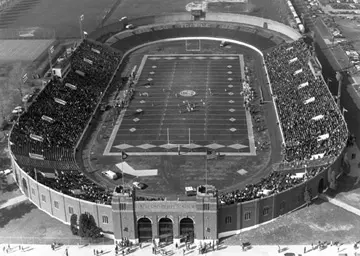
OWLS' FOOTBALL TO PLAY FOR FINAL TIME ON HISTORIC TEMPLE STADIUM FIELD
4.22.02 | Football
Temple Stadium, dedicated on October 13, 1928 and demolished in January, 1997, has a long and storied tradition. Although the stadium itself no longer stands, the field upon which some of college football's greatest players competed, remains. Located at Vernon Road and Michener Street in Northwest Philadelphia, Temple Stadium played host to Owl leather-luggers for 47 seasons, from 1928 to 1974.
The Owls made their debut on the field on Sept. 29,1928, against St. Thomas College of Scranton, two weeks before the stadium's dedication. Team captain Howard "Barney" Gugel made it a successful debut, scoring on a 66-yard fumble recovery and a 38-yard interception return for a 12-0 Temple victory. The win was the first of six consecutive shutout victories for Temple on its new home turf. The final contest on the field came on October 19, 1974 when the Owls dismantled eastern foe Holy Cross, 56-0. The victory was the 13th of a school-record 14 consecutive wins for the Owls and saw Maxwell Award winner and current Temple broadcaster Steve Joachim throw five touchdown passes.
In between these contests, an estimated 263 games took place on the Temple Stadium grass, featuring some of college football's greatest players, coaches and teams. One of the most notable performances there belonged to visitor Davey O'Brien. In one half of action, the unanimous All-American tossed four touchdown passes, leading Texas Christian to a 28-6 win on October 7, 1938. Other opponents of note include Georgia's Charlie Trippi, Southern Methodist's Doak Walker and Pittsburgh's Marshall Goldberg. No less than nine Temple All-Americans also graced the Temple Stadium gridiron, including Bucko Kilroy (1941), Phil Slosburg (1947), Doug Shobert (1971), Randy Grosssman (1972), Bill Singletary (1972), Steve Joachim (1974), Pat Staub (1974), Henry Hynoski (1974) and Joe Klecko (1974).
Glenn S. "Pop" Warner directed the Owl gridders at Temple Stadium from 1933-38. Lured away from Stanford by Temple in December 1932, Warner was one of football's great innovators, pioneering the use of several offensive formations including the single wing, the double wing and the unbalanced line. Other coaches of renown that had teams on the Temple Stadium field were Villanova's Harry Stuhldreher, who gained fame as one of Notre Dame's "Four Horsemen," and Temple's Ray Morrison (1940-48), who is believed to have pulled off the first "Statue of Liberty" play at Vanderbilt before directing SMU's "Flying Circus" offense. Bobby Bowden (West Virginia) and Lou Holtz (William & Mary) also paced its sidelines before winning national championships at Florida State and Notre Dame, respectively, later in their careers.
The Temple Stadium field also played host to many rivalries, including the Owls' battles with Bucknell for "The Old Shoe" from 1927-70 and many hard-fought contests with Penn State, Villanova, Rutgers and Delaware. Teams of note that played on the Temple Stadium field include Texas, Syracuse, Oklahoma, Iowa, Michigan State and Mississippi.
The Temple Stadium site was sold to Enon Tabernacle Baptist Church in December 2001 with the University retaining a license agreement on the field through June 30, 2002.