Temple University Athletics
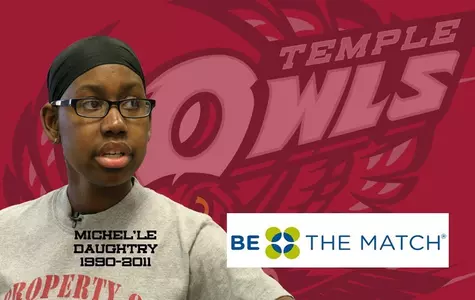
Michel'Le Daughtry, a former student equipment manager, inspired the football team to "Be the Match."
Get in the Game! Save a Life!
3.28.14 | Football
See Flier
Temple University Football Program is hosting a marrow registration drive in memory of former equipment manager Michel'le Daughtry to help save lives!
Temple University Football Program is hosting a marrow registration drive in memory of former equipment manager Michel'le Daughtry to help save lives!
Temple University community, area residents and businesses encouraged to join marrow registry.
What: Temple University teams up with Be The Match Registry in their effort to recruit 5,000 new members to the marrow registry right here in Philadelphia along with Villanova and other universities participating in drives. Thousands of patients with leukemia, sickle cell and other life-threatening diseases depend on Be The Match to find a life saving match through the "Get In The Game, Save A Life" program.
University faculty, staff and students and area residents can join the registry on Monday, April 14, 2013, from 11:00am thru 3:00pm at the Howard Gittis Student Center on Temple University's Main Campus.
Donors with diverse racial or ethnic backgrounds are especially critical as patients in need of a transplant are most likely to match someone of their own race or ethnicity.
When/Where:
April 14, 2014
Howard Gittis Student Center - Room 200
13th St & Montgomery Avenue
Philadelphia, PA 19122
11:00am to 3:00pm
Why: Former student equipment manager for the Temple football team from 2007 to 2011, Michel'Le (Misha) Daughtry was diagnosed with Leukemia in the summer of 2008 days before Pre-Season Training camp. Throughout Misha's three year battle with Leukemia, she continued work and be an inspiration to the football team any and every chance she had. Misha received a bone marrow transplant that allowed her to live a longer life and to continue to be an inspiration to the staff and players of the Temple Football program. Temple held three drives throughout the time that Daughtry had cancer.
Graduate Extern Athletic Trainer, Marc Schaffer who originally signed up for the registry through the Temple Football Get In The Game marrow drive became a donor in April 2013. In addition to Temple more than 34 universities are participating in the program.
The Importance of Every Dollar Donated: How your dollars save lives
$25 Dollars- Covers one clinic visit co-pay. Patients must visit the transplant clinic daily or weekly during their three to six months of outpatient recovery. Clinic co-pays can add up to $300 a month
$50 Dollars- covers two days of meals for a patient and their caregiver during outpatient recovery.
$75 Dollars- Supplies laboratory researchers with critical materials to conduct ground-breaking medical research.
$100 Dollars- covers the cost to add one potential marrow donor to the Be The Match Registry, giving more searching patients hope for a cure.
$250 Dollars- covers 10 monthly prescription co-pays. Many patients take 20 or more medications per day during recovery—that's $500 in prescription co-pays each month.
$500 Dollars-provides two weeks of temporary housing during recovery. If patients live more than an hour away from the transplant center they are required to relocate and live nearby for the three to six months of recovery. Many families spend $800-$1000 a month on temporary housing, while also covering a mortgage back home.
Becoming a Match
IF YOU MATCH A PATIENT:
Below are the steps to donation if you are identified as a match for someone.
TWO WAYS TO DONATE
The patient's doctor requests one of two types of donation, depending on what is best for the patient.
PBSC donation
Peripheral blood stem cell (PBSC) donation is the most common form of donating today. This is a non-surgical, out-patient procedure. For five days before donation, the donor receives daily injections of a drug that increases blood-forming cells in the bloodstream. On the fifth day, the donor's blood is removed through a needle in one arm and passed through a machine that separates out the blood-forming cells. The remaining blood is returned to the donor through the other arm.
Marrow donation
Marrow donation is a surgical, usually out-patient procedure. While the donor us under anesthesia, the doctor uses needles to withdraw liquid marrow from the back of the pelvic bone. The donor's marrow completely replaces itself within four to six weeks. After donation, marrow donors will have slight soreness, but they are back to their usual routine in one to seven days.


Tuesday, June 02
Saturday, May 30
Tuesday, May 19
Tuesday, May 05