Temple University Athletics
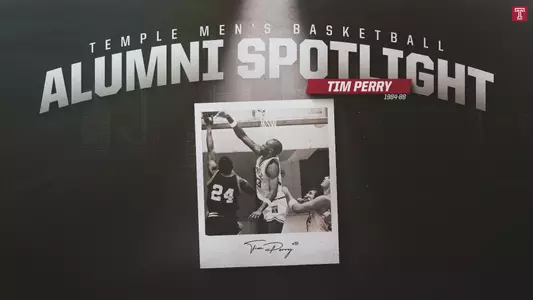
Temple MBB Alumni Spotlight: Tim Perry
8.18.23 | Men's Basketball
A four-year starter for the Temple from 1984-88, Tim Perry played on four NCAA Tournament teams during his career, including the Owls' 1988 team that posted a 32-2 record and was ranked No. 1 in the nation the final five weeks of the regular season.
The Freehold, N.J. native scored 1,368 points (32nd at Temple) as a four-year starter while pulling down 985 rebounds (7th all-time at TU). He made 553 of his 1,106 field goal attempts, ranking first on the Owls' all-time field goal percentage list (.544), but he is best known for his shot-blocking prowess. The 6-9 forward rejected a school record 392 blocked shots, which ranked second in NCAA history at the time his career ended (now 25th).
During his time at Temple, the Owls posted an incredible 114-18 won-loss record, including consecutive school-record 32-win seasons. A two-time First Team all-Atlantic 10 Conference and All-District honoree, Perry was named the 1988 A-10 Player of the Year and would be drafted with the seventh pick of the first round of the NBA Draft by the Phoenix Suns.
Perry played eight seasons in the NBA, three with the Philadelphia 76ers, before ending his playing career with five seasons in the Spanish professional league.
He currently is a real estate agent and continues to work youth camps for the 76ers.
Talk about your reason for choosing Temple.
"I was undecided on my choice of college and received a letter from Temple and came to visit. Coach (John) Chaney and Coach (Jim) Maloney took me around campus and it was really nice. I loved the city. My mother and father had a chance to meet Coach Chaney and Coach Maloney and they fell in love with them. Coach Chaney told them that he would be my father when they were not around and they really loved that.
Besides that, I fell in love with Temple University. My visit was great. I met a lot of nice people on campus. I really liked the school."
You sat out your first season but became a fixture in the middle for the Owls and one of the premier shot blockers in the history of college basketball. Talk about your career and what it means to you when you look back on those four seasons at Temple.
"I really commend Coach Chaney because he waited for me. When you go into your freshman year you think you are going to do well right away. At the beginning of the season, I lost my confidence. I knew I could play defense and could block shots. Whoever I was covering, I knew I could keep them under their average.
Coach Chaney used to get on me a little bit, though. A couple of times he called me the 6-9 invisible man because I would play 22 minutes and average two points per game. But I stayed on the court because of my defense. I really commend coach because a lot of other coaches would have had me sitting on the bench, but he gave me a chance.
Playing Georgetown in the NCAAs my freshman year, I felt like we were overmatched. I felt I was a big part of that because even though Patrick Ewing was a great big man, I did not give him any resistance. I felt like I did not do anything in that game. So, I knew I had a lot of work to do.
After my freshman year, I went into the gym knowing I needed to get some confidence as the next year Granger Hall was leaving and I had to pick up my scoring. During my sophomore year, everything came together. What helped me out was the Sonny Hill League that summer and playing against good competition. Besides my growth as a player in my sophomore year, everyone else was growing too. That was because everyone started working together the day after we lost to Georgetown to get better.
My junior year we continued to get better with hard work. My senior year, when we lost Nate (Blackwell), we thought we were going to slip, but Mark Macon filled that void for us."
How special was your senior season? It was arguably the best season in Temple Basketball history with the team entering the NCAA Tournament as the No. 1 team in the country.
"I think having Mark (Macon) there was key as his defense was so good as was Howie's (Evans). They were above-average defensive players, and I was as well. That really helped us out. Mike Vreeswyk and Ramon Rivas did their jobs, too. Mike really could shoot the ball well and, at 6-7, no one expected him to be as strong a rebounder as he was. Sometimes when we lacked in rebounding Mike picked us up. Everyone matured over the summer heading into the year and when the season started, we were all on the same page.
One thing about our team is that we could take constructive criticism. Anyone could get on me about not grabbing enough rebounds, or someone not doing their job, and we never took it personally. Through that, our team got a lot better. There was a lot of pressure on us that year because sometimes the smallest teams would give us the hardest times. We hated seeing teams like Penn State and West Virginia because we could never blow them out. Our conference teams gave us a hard time.
Our first loss was to UNLV and I can remember that game like it was yesterday. Their big guy came off the bench and I was about to block his shot, but he bobbled the ball which threw my timing off and he made his shot. Everybody on my team was like, 'Why didn't you block his shot?' I never thought Coach Chaney thought about it until we were at some banquet and Coach Chaney says, 'We would have been 33-1 if Tim Perry would have jumped up and blocked that shot.'
That year, though, I knew we were finally there. We could not read our press clippings, but we were like a Rock and Roll band with everyone in the country supporting us. We had all of Philadelphia, Pennsylvania, and New Jersey on Temple's bandwagon. It was a special year,"
Now talk about your professional career. How nice was Draft Night and being selected in the first round by the Phoenix Suns with the No. 7 pick overall?
"When I came to Temple, I just was focused on being a basketball player here. I never thought about the NBA, ever. People started talking about it to me in my junior and senior years, and Coach Chaney even changed his language with me. He started saying, 'If you ever get to the NBA' and later changed it to 'When you play in the NBA.'
I credit Coach Chaney for my development. I did not come to Temple to be an NBA player, but just to be on the basketball team here. All of his and the rest of the staff's coaching came to fruition for me, so Draft Day was the biggest day of my life.
After playing with the Suns, you were traded to your hometown team, the Philadelphia 76ers. How special was it to play for the home team?
"It was hard leaving the Suns because we were a playoff team. We had just knocked off the Lakers and had been winning 50 games a year. Kevin Johnson was my best friend, but coming back to Philadelphia had me excited because I was coming back home.
I had heard the trade rumors but did not think anything about it. I went to ask my coach, Paul Westphal, if I was getting traded and he said I wasn't. He said, 'No matter what you do you will always hear trade rumors.' A week later I was in Philadelphia, and I was excited to be back home.
The trade was Charles Barkley for me, Andrew Lang, and Jeff Hornacek. We had a coach by the name of Doug Moe, but he only lasted about half a year. That was the hardest part of playing with Philadelphia, that we never had a coach for a long time but I did get a lot of Philly love when I played here. We went through some rough stretches, but the fans never bothered me."
Talk about your final professional seasons overseas.
"I played in Spain for four and a half years. I loved it over there. In the beginning, I did not think I was going to make it because I was homesick. It took me about two or three months to get into the culture. You just really have to get used to being overseas because it is fun, but it can be lonely over there too. I did make a lot of friends though.
My first year over there the team I was on was in 16th place. There, you have two championships with one in the middle of the season. So that first year we won the championship in the middle of the season, and everyone was going crazy. It felt like Temple won an NCAA Tournament game. It was the first time our team, Pamesa Valencia, won a championship, which was really nice. We had a big parade. That was the team I was the closest with during my time playing in Spain and I still keep in contact with players from that team."
What have you been doing since you stopped playing professionally?
"I coached a little bit, part-time at Holy Family University. I was into real estate and had some investment properties. Then I got my real estate license and that is what I do now, but I also have a part-time job with the Sixers. I have been doing youth basketball camps with them for over 30 years. I love these camps. When I see the kids, my energy goes up another level."
What advice do you have for members of the current Temple Owls team?
"As players, everyone has to look in the mirror and see what skill and talent they have and bring that to the coach. The coach can then decide how to use the players in the best way. One thing you should never do is look elsewhere or point the finger. Everyone must be on the same page. That is the most important thing. Also, keep improving every day. Put on your work hat and go to the gym and work on your skills. As long as you are in it for the long road, everything will work out."
The Freehold, N.J. native scored 1,368 points (32nd at Temple) as a four-year starter while pulling down 985 rebounds (7th all-time at TU). He made 553 of his 1,106 field goal attempts, ranking first on the Owls' all-time field goal percentage list (.544), but he is best known for his shot-blocking prowess. The 6-9 forward rejected a school record 392 blocked shots, which ranked second in NCAA history at the time his career ended (now 25th).
During his time at Temple, the Owls posted an incredible 114-18 won-loss record, including consecutive school-record 32-win seasons. A two-time First Team all-Atlantic 10 Conference and All-District honoree, Perry was named the 1988 A-10 Player of the Year and would be drafted with the seventh pick of the first round of the NBA Draft by the Phoenix Suns.
Perry played eight seasons in the NBA, three with the Philadelphia 76ers, before ending his playing career with five seasons in the Spanish professional league.
He currently is a real estate agent and continues to work youth camps for the 76ers.
Talk about your reason for choosing Temple.
"I was undecided on my choice of college and received a letter from Temple and came to visit. Coach (John) Chaney and Coach (Jim) Maloney took me around campus and it was really nice. I loved the city. My mother and father had a chance to meet Coach Chaney and Coach Maloney and they fell in love with them. Coach Chaney told them that he would be my father when they were not around and they really loved that.
Besides that, I fell in love with Temple University. My visit was great. I met a lot of nice people on campus. I really liked the school."
You sat out your first season but became a fixture in the middle for the Owls and one of the premier shot blockers in the history of college basketball. Talk about your career and what it means to you when you look back on those four seasons at Temple.
"I really commend Coach Chaney because he waited for me. When you go into your freshman year you think you are going to do well right away. At the beginning of the season, I lost my confidence. I knew I could play defense and could block shots. Whoever I was covering, I knew I could keep them under their average.
Coach Chaney used to get on me a little bit, though. A couple of times he called me the 6-9 invisible man because I would play 22 minutes and average two points per game. But I stayed on the court because of my defense. I really commend coach because a lot of other coaches would have had me sitting on the bench, but he gave me a chance.
Playing Georgetown in the NCAAs my freshman year, I felt like we were overmatched. I felt I was a big part of that because even though Patrick Ewing was a great big man, I did not give him any resistance. I felt like I did not do anything in that game. So, I knew I had a lot of work to do.
After my freshman year, I went into the gym knowing I needed to get some confidence as the next year Granger Hall was leaving and I had to pick up my scoring. During my sophomore year, everything came together. What helped me out was the Sonny Hill League that summer and playing against good competition. Besides my growth as a player in my sophomore year, everyone else was growing too. That was because everyone started working together the day after we lost to Georgetown to get better.
My junior year we continued to get better with hard work. My senior year, when we lost Nate (Blackwell), we thought we were going to slip, but Mark Macon filled that void for us."
How special was your senior season? It was arguably the best season in Temple Basketball history with the team entering the NCAA Tournament as the No. 1 team in the country.
"I think having Mark (Macon) there was key as his defense was so good as was Howie's (Evans). They were above-average defensive players, and I was as well. That really helped us out. Mike Vreeswyk and Ramon Rivas did their jobs, too. Mike really could shoot the ball well and, at 6-7, no one expected him to be as strong a rebounder as he was. Sometimes when we lacked in rebounding Mike picked us up. Everyone matured over the summer heading into the year and when the season started, we were all on the same page.
One thing about our team is that we could take constructive criticism. Anyone could get on me about not grabbing enough rebounds, or someone not doing their job, and we never took it personally. Through that, our team got a lot better. There was a lot of pressure on us that year because sometimes the smallest teams would give us the hardest times. We hated seeing teams like Penn State and West Virginia because we could never blow them out. Our conference teams gave us a hard time.
Our first loss was to UNLV and I can remember that game like it was yesterday. Their big guy came off the bench and I was about to block his shot, but he bobbled the ball which threw my timing off and he made his shot. Everybody on my team was like, 'Why didn't you block his shot?' I never thought Coach Chaney thought about it until we were at some banquet and Coach Chaney says, 'We would have been 33-1 if Tim Perry would have jumped up and blocked that shot.'
That year, though, I knew we were finally there. We could not read our press clippings, but we were like a Rock and Roll band with everyone in the country supporting us. We had all of Philadelphia, Pennsylvania, and New Jersey on Temple's bandwagon. It was a special year,"
Now talk about your professional career. How nice was Draft Night and being selected in the first round by the Phoenix Suns with the No. 7 pick overall?
"When I came to Temple, I just was focused on being a basketball player here. I never thought about the NBA, ever. People started talking about it to me in my junior and senior years, and Coach Chaney even changed his language with me. He started saying, 'If you ever get to the NBA' and later changed it to 'When you play in the NBA.'
I credit Coach Chaney for my development. I did not come to Temple to be an NBA player, but just to be on the basketball team here. All of his and the rest of the staff's coaching came to fruition for me, so Draft Day was the biggest day of my life.
After playing with the Suns, you were traded to your hometown team, the Philadelphia 76ers. How special was it to play for the home team?
"It was hard leaving the Suns because we were a playoff team. We had just knocked off the Lakers and had been winning 50 games a year. Kevin Johnson was my best friend, but coming back to Philadelphia had me excited because I was coming back home.
I had heard the trade rumors but did not think anything about it. I went to ask my coach, Paul Westphal, if I was getting traded and he said I wasn't. He said, 'No matter what you do you will always hear trade rumors.' A week later I was in Philadelphia, and I was excited to be back home.
The trade was Charles Barkley for me, Andrew Lang, and Jeff Hornacek. We had a coach by the name of Doug Moe, but he only lasted about half a year. That was the hardest part of playing with Philadelphia, that we never had a coach for a long time but I did get a lot of Philly love when I played here. We went through some rough stretches, but the fans never bothered me."
Talk about your final professional seasons overseas.
"I played in Spain for four and a half years. I loved it over there. In the beginning, I did not think I was going to make it because I was homesick. It took me about two or three months to get into the culture. You just really have to get used to being overseas because it is fun, but it can be lonely over there too. I did make a lot of friends though.
My first year over there the team I was on was in 16th place. There, you have two championships with one in the middle of the season. So that first year we won the championship in the middle of the season, and everyone was going crazy. It felt like Temple won an NCAA Tournament game. It was the first time our team, Pamesa Valencia, won a championship, which was really nice. We had a big parade. That was the team I was the closest with during my time playing in Spain and I still keep in contact with players from that team."
What have you been doing since you stopped playing professionally?
"I coached a little bit, part-time at Holy Family University. I was into real estate and had some investment properties. Then I got my real estate license and that is what I do now, but I also have a part-time job with the Sixers. I have been doing youth basketball camps with them for over 30 years. I love these camps. When I see the kids, my energy goes up another level."
What advice do you have for members of the current Temple Owls team?
"As players, everyone has to look in the mirror and see what skill and talent they have and bring that to the coach. The coach can then decide how to use the players in the best way. One thing you should never do is look elsewhere or point the finger. Everyone must be on the same page. That is the most important thing. Also, keep improving every day. Put on your work hat and go to the gym and work on your skills. As long as you are in it for the long road, everything will work out."
MBB Press Conference vs. Princeton (Adam Fisher)
Monday, December 22
MBB Press Conference vs.Princeton (Babatunde Durodola and Jordan Mason)
Monday, December 22
Temple Men's Basketball 2025-26 All Access | Game 12 at Davidson 12.18.2025
Sunday, December 21
Ep. 29: Last Episode of First Semester from David & Amelia
Wednesday, December 17