Temple University Athletics
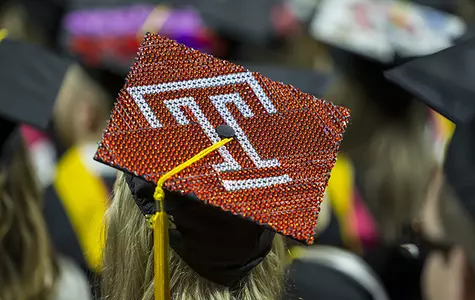
Photo by: Joseph V. Labolito/Temple University
From Temple of Doom to Temple of Bloom: How Temple University Transformed Its Athletes Into Student-Athletes
8.8.16 | Field Hockey, Football, Men's Basketball, Men's Crew, Men's Cross Country, Men's Golf, Men's Soccer, Men's Tennis, Women's Basketball, Women's Rowing, Women's Cross Country, Women's Fencing, Women's Gymnastics, Women's Lacrosse, Women's Soccer, Women's Tennis, Women's Track and Field, Women's Volleyball
Once upon a time, Temple University athletic administrators cowered whenever data about academics were being released.
This wasn't a "once upon a time" in a fairy tale sense. This was real. And the numbers were bad.
Academically, the football team was rated the worst among NCAA Division I FBS schools. The basketball team was in the lower 25 percent academically. There was fear and animosity when it was time to release the annual data.
That "once upon a time" was only 10 years ago. Today, Temple is a shining star of how to do things the correct way academically.
"We want to get the story out of what we're doing here. Not a lot of people understand how bad it really was – and how great it is right now," said Justin Miller, who is Temple's Senior Director of the Resnick Academic Support Center for Student-Athletes.
"We stress academics more than anything, and we're really doing this at a high level," said Dr. Patrick Kraft, Temple's Director of Athletics. Kraft fully comprehends the student-athlete experience; a linebacker at Indiana University, he earned a bachelor's degree in sports marketing/management (2000), a master's degree in athletic administration (2005), and a doctorate in sports management (2008). "Our student-athletes are truly phenomenal. What we're doing from an academic standpoint is amazing.
"The role of college athletics is we're a social connector, we're a great marketing tool for the university, and – when done right – you represent the university in the best regard. That's what athletics truly means. Our academic success is another way to highlight the academic success of the university."
This is the story of Temple's transformation. This is the story of how to do things right.
* * * * *
In 2003, the NCAA implemented the Academic Progress Rate (APR) at the Division I level, which holds institutions accountable for the academic progress of their student-athletes.
APR is a team-based metric that accounts for the eligibility and retention of every student-athlete for each academic term. APR is designed to provide a real-time assessment of a team's academic performance, and it includes rewards for superior academic performance and penalties for teams that do not achieve certain academic benchmarks. The numbers are collected annually, and results are announced every spring.
When the data were first released, Temple's football team was the lowest in the nation among FBS schools. In plain English, for schools with football, no one was worse than Temple. The APR for the football team for the 2004-2005 school year was 837 (out of a maximum of 1,000) – which led to significant NCAA penalties; the football team lost nine football scholarships for its abysmal academic performance. The men's basketball team's APR was just 900. The overall APR for the athletic department stood at 949.
The first-year APR data served as a major wakeup call for the university. After the initial data were released, Temple University President David Adamany and University Provost Ira Schwartz moved the athletic department's academic support to the Provost's portfolio – and entrusted Dr. Peter Jones to oversee an academic resurrection.
On paper, appointing Jones as the Senior Vice Provost and tasking him to overhaul the academic side of student-athletes might have been seen as "outside the box" thinking. Jones was a graduate of Aberystwyth University in Wales and a professor of criminal justice – having joined the Temple University faculty in 1985.
In reality, Jones was an ideal choice; he was the parent of a Division I student-athlete. His daughter, Rhian, was a highly recruited field hockey player who attended Duke University – where she earned all-Atlantic Coast Conference honors both athletically and academically.
Jones knew Temple had a long way to go. His dual role as father and academic allowed him to see what other schools were doing right from different angles.
"The first thing I did was go to Duke. Then I went to North Carolina State. I took a look at what they did to support student-athletes," he said. "And then, as I traveled around to watch my daughter play, I would check out the universities that I thought had student support centers that we might want to emulate. For four-to-five months, I'd go into these universities and talk to the staff and directors there. I just picked up ideas from different places – and that's how we developed the center here. It created a vision of what we needed to accomplish.
"I was fortunate that both the President and the Provost agreed to give me a budget that allowed us to hire an appropriate number of advisors and learning specialists. In my opinion, the critical difference is that we built the Academic Support Center within the Provost's office – and not within the department of athletics. So we had the separation. I think that made a big difference."
Indeed, Jones' initial focus was to develop and construct the Academic Support Center – which was officially renamed the Nancy & Donald Resnick Academic Support Center for Student-Athletes in 2012. Student-athlete academic advising fell under his department's domain, and customized support was created for individual students. It was the first step in changing the culture.
"Eight years ago when we started it, we wanted to emulate what was being done at some of the better places for a fraction of their budget," he said. "I figured if we did it smart, we could do it as well for less – and we have."
But it didn't happen overnight. There were some conflicts along the way. Initially, there wasn't a collaborative dynamic due to a lack of leadership in the Resnick Center. There was a revolving door as it related to support center management.
All of that changed in 2010, when Miller came aboard to run the Resnick Center.
"I knew what I was getting into when I came here," said Miller, who had spent the previous five years in a similar role with the University of South Florida. "I was really excited about the resources put into place by Dr. Jones. I knew things were going in the right direction.
"Coming in, all the pieces were in place. I met the people in athletics, and they seemed committed. Given the public nature of these things, they needed it to improve. It sounded like there was a lot of buy-in. This was a place where I knew there was a pretty high ceiling on things for what we could do."
Miller didn't arrive on campus with blinders on. He knew that just five years prior to his arrival, there had been a lot of ineligible student-athletes.
"The first year the APR data were released, Temple had lost 49 eligibility points in football," he said. "The last five years since I've been here, we've lost 29 points combined. And I will tell you that's too many.
"Let's face it; I knew it had been bad here. There had been turmoil. It was disorganized. In a nutshell, all of the metrics the NCAA uses – we had been considerably below average."
* * * * *
In order to change the culture – and for academics to become the priority that it's supposed to be on a college campus – coaches had to understand that education came first.
Just as important, bridges with the faculty needed to be repaired.
As Jones recalled, faculty didn't initially believe in any sort of academic renaissance among student-athletes.
"Ten years ago, faculty were not on board with athletics," he said. "From an academic perspective, we really weren't in a good place."
And then Jones made a suggestion.
"I have been saying we need to do a case study of a faculty member who was not entirely positive about our student-athletes. But then he had a number of student-athletes in his class and had positive interactions with the Resnick Center. Now, he's become one of the biggest academic boosters for students that we have. In the space of about six years, this person has gone completely from one end of the scale to the other. And we are going to ask him to write an essay for the Faculty Senate newsletter to reflect on why it is that he has become so positive about student-athletes and what we do. His name is Dr. Scott Gratson."
Gratson, who describes himself as being "completely and utterly unathletic," has become a champion of Temple's student-athlete experience despite being disinterested in sports.
Gratson, the School of Media and Communication's director of communication studies and director of undergraduate studies, began his Temple career in 2002 in the Department of Strategic Communication. When he first arrived on campus, he said he would hear quite a few stories about the basketball team. "At that point in time, basketball had a pretty large reputation both in Philadelphia and at Temple – and it wasn't very positive because it was this idea that they were the gods of campus. Everywhere I looked, I just saw these images of basketball and nothing about Temple academics whatsoever.
"Where it came to a head with me wasn't basketball, though, but with football. It was with a former coach – at a Welcoming Convocation. You have all the incoming students – and this was a sizable population – and faculty and staff were present. The football coach got on the stage and basically told students to skip class. He said they needed to go to football games. And he was saying this in front of faculty members who were wearing robes and total academic regalia. All of us were looking around and saying, 'He didn't just say that they should basically skip class to go to a football game, did he?' But that's exactly what he said. That was an example of how bad it had gotten. It wasn't just a little bit of slightly bad blood. It was this idea that football could do whatever it wanted … that athletics could do whatever it wanted and that academics was tertiary at best. That was probably the point where it was the worst of relationships. In fact, I wrote an article against the coach for saying that in our faculty newspaper."
After Miller was hired, one of the first things he did was begin to build relationships with faculty and coaches.
"For me, the faculty piece is tremendous," Miller said. "One of the things we do a really good job of – and one of the things we have done to shift the faculty who might not be predisposed to engage with our office or see the value of athletics – is let them know we put the students first. That mentality takes us in a different direction with professors. Some of the faculty might not be interested in engaging with us – and I'm OK with that – but they will engage with our students. So our conversations with students include having them visit their professors during office hours. And our coaches are engaged in this as well, and they make sure the students go. We stress that to our students. And when the students start creating relationships with their professors – that's when perceptions change."
Gratson, like many other faculty members, looked at the athletic department as its own little world "that might as well have been on Pluto." But Miller helped alter those perceptions immediately by creating relationships with the faculty. "That carries a lot of weight in faculty land," Gratson said. "If a person is willing to create a bridge with us, that carries a lot of clout.
"I can remember the exact day things changed. I was working on a student affairs case with Justin that was at the intersection of student affairs, academics and athletics – and it dealt with some element of student conduct. New coaches had arrived with the football team, and Justin came up to me after the meeting – which was admittedly a rather tense meeting – and he said, 'Look, why don't we start over. Would you be willing to talk to the football coach?' I said, 'You can't be serious?' He said, 'I'm being dead serious. The football coach wants to speak with you.'
"The next thing you know, the football coach came to my office. This was a guy I had never met before. I was just in a very tense committee hearing about his players, and he came to my office, in my building – which is on the other side of campus from where he's at – and he wanted to meet with me one-on-one. It totally floored me. And he sat in my office along with Justin, and we talked about how he was viewing academics and about how he was viewing behavior from his players – and that the behavior that was exhibited in the past was no longer acceptable. And if a player was to behave like that, he would be gone. He said it out loud … 'I will ask him to leave. If a player wasn't keeping up in the classroom, then that player wasn't welcome on my team.'
"I was totally floored. First of all, the football coach came to my office. Secondly, the football coach said if players weren't interested in being good students, then I don't want them – which was a complete 180 from things that we saw happening up to that point. Then he said I should meet some of the players one-on-one. And I thought, 'There's no way.' Here I was, just a few months ago, screaming about how I couldn't stand the players, and how I thought they were privileged and everything. This was a recipe for disaster.
"Three football players signed up for one of my classes – and they all showed up one-by-one during my office hours. We ended up having some of the best conversations. One player played three different types of guitars; he's extremely well-trained in classical guitar theory. Another was a concert-grade cellist. Another wrote poetry. I would never have thought this stuff. I started to see them as students who play football as one of their many crafts.
"I have become one of the biggest advocates to tell faculty that if they're not giving student-athletes a chance, they need to change their mentality. They're really missing out on the possibilities for a very positive relationship. If you just see them only as an athlete, you're missing out on your responsibility as a teacher. I know that I never would have thought that way until I started talking with them."
* * * * *
During Miller's time at Temple, the number of full-time staff has remained unchanged. Within his office though, more stability and more professional opportunities have resulted.
Physical space for academic advising has been enhanced significantly. Coaches now have required weekly meetings with academic advisers. Administrative and faculty support has increased dramatically.
A hallmark of the Temple student-athlete experience is open-access majors and career-development opportunities. There are 34 majors represented among current football players.
What does this all mean for Temple? The public release of APR used to be a disturbing experience. Now, it's another occasion to celebrate academic progress.
With the NCAA tying resources and postseason to it, APR has become something that people are paying attention to. Temple has benefitted from changing its mentality and scrutinizing those numbers.
"Since APR was implemented, Temple football is one of two schools in the nation (along with Purdue) whose APR has never gone down," Miller said. "I realize that clearly says that we weren't good, but it's one of those situations where we've never decreased. We continue to rise.
"One of the things I appreciate is the value of data in telling a story. This past year, I was running some of our numbers around the time the new APR data came out, and it was pretty cool. We were one of 11 schools in the nation that had APR for all of its teams over 970. Duke, Northwestern, Alabama, Michigan, Notre Dame, Texas, Toledo, Virginia, Washington, Vanderbilt and Temple … not bad company. The stat was awesome, and it's something we're very proud of. The numbers are all public; I just ran it and filtered it. We have gone from being among the worst to now – for our entire program – we're one of 11.
"This is now the new normal. This is what we expect. We tell recruits … you'll graduate. You're going to have the support. You're going to be challenged to work hard. It's about getting educated. We want people to know you're Temple-made. You're a well-educated young man or woman, and you're ready to hit the ground running in the workforce."
The APR numbers for the 2015-2016 academic year speak volumes: 988 for the overall athletic department – and 979 for both football and men's basketball.
And a new bar has been set; each of the last two springs, the grade point average for Temple student-athletes has surpassed the 3.2 mark – above the school's 3.05 GPA for traditional students.
"We're proud of our athletic success, but we try to do everything we can to showcase our academic success – because they're so impressive," said Kraft. "We are a great example of how you can be successful in the classroom, in the community and on the playing field. That's what we're really proud about. But it takes a commitment from everybody in order to do that. Coaches have to buy in. Administrators have to buy in. Athletes have to buy in. It's now ingrained in our culture of who we are and who we're always going to be."

This wasn't a "once upon a time" in a fairy tale sense. This was real. And the numbers were bad.
Academically, the football team was rated the worst among NCAA Division I FBS schools. The basketball team was in the lower 25 percent academically. There was fear and animosity when it was time to release the annual data.
That "once upon a time" was only 10 years ago. Today, Temple is a shining star of how to do things the correct way academically.
"We want to get the story out of what we're doing here. Not a lot of people understand how bad it really was – and how great it is right now," said Justin Miller, who is Temple's Senior Director of the Resnick Academic Support Center for Student-Athletes.
"We stress academics more than anything, and we're really doing this at a high level," said Dr. Patrick Kraft, Temple's Director of Athletics. Kraft fully comprehends the student-athlete experience; a linebacker at Indiana University, he earned a bachelor's degree in sports marketing/management (2000), a master's degree in athletic administration (2005), and a doctorate in sports management (2008). "Our student-athletes are truly phenomenal. What we're doing from an academic standpoint is amazing.
"The role of college athletics is we're a social connector, we're a great marketing tool for the university, and – when done right – you represent the university in the best regard. That's what athletics truly means. Our academic success is another way to highlight the academic success of the university."
This is the story of Temple's transformation. This is the story of how to do things right.
* * * * *
In 2003, the NCAA implemented the Academic Progress Rate (APR) at the Division I level, which holds institutions accountable for the academic progress of their student-athletes.
APR is a team-based metric that accounts for the eligibility and retention of every student-athlete for each academic term. APR is designed to provide a real-time assessment of a team's academic performance, and it includes rewards for superior academic performance and penalties for teams that do not achieve certain academic benchmarks. The numbers are collected annually, and results are announced every spring.
When the data were first released, Temple's football team was the lowest in the nation among FBS schools. In plain English, for schools with football, no one was worse than Temple. The APR for the football team for the 2004-2005 school year was 837 (out of a maximum of 1,000) – which led to significant NCAA penalties; the football team lost nine football scholarships for its abysmal academic performance. The men's basketball team's APR was just 900. The overall APR for the athletic department stood at 949.
The first-year APR data served as a major wakeup call for the university. After the initial data were released, Temple University President David Adamany and University Provost Ira Schwartz moved the athletic department's academic support to the Provost's portfolio – and entrusted Dr. Peter Jones to oversee an academic resurrection.
On paper, appointing Jones as the Senior Vice Provost and tasking him to overhaul the academic side of student-athletes might have been seen as "outside the box" thinking. Jones was a graduate of Aberystwyth University in Wales and a professor of criminal justice – having joined the Temple University faculty in 1985.
In reality, Jones was an ideal choice; he was the parent of a Division I student-athlete. His daughter, Rhian, was a highly recruited field hockey player who attended Duke University – where she earned all-Atlantic Coast Conference honors both athletically and academically.
Jones knew Temple had a long way to go. His dual role as father and academic allowed him to see what other schools were doing right from different angles.
"The first thing I did was go to Duke. Then I went to North Carolina State. I took a look at what they did to support student-athletes," he said. "And then, as I traveled around to watch my daughter play, I would check out the universities that I thought had student support centers that we might want to emulate. For four-to-five months, I'd go into these universities and talk to the staff and directors there. I just picked up ideas from different places – and that's how we developed the center here. It created a vision of what we needed to accomplish.
"I was fortunate that both the President and the Provost agreed to give me a budget that allowed us to hire an appropriate number of advisors and learning specialists. In my opinion, the critical difference is that we built the Academic Support Center within the Provost's office – and not within the department of athletics. So we had the separation. I think that made a big difference."
Indeed, Jones' initial focus was to develop and construct the Academic Support Center – which was officially renamed the Nancy & Donald Resnick Academic Support Center for Student-Athletes in 2012. Student-athlete academic advising fell under his department's domain, and customized support was created for individual students. It was the first step in changing the culture.
"Eight years ago when we started it, we wanted to emulate what was being done at some of the better places for a fraction of their budget," he said. "I figured if we did it smart, we could do it as well for less – and we have."
But it didn't happen overnight. There were some conflicts along the way. Initially, there wasn't a collaborative dynamic due to a lack of leadership in the Resnick Center. There was a revolving door as it related to support center management.
All of that changed in 2010, when Miller came aboard to run the Resnick Center.
"I knew what I was getting into when I came here," said Miller, who had spent the previous five years in a similar role with the University of South Florida. "I was really excited about the resources put into place by Dr. Jones. I knew things were going in the right direction.
"Coming in, all the pieces were in place. I met the people in athletics, and they seemed committed. Given the public nature of these things, they needed it to improve. It sounded like there was a lot of buy-in. This was a place where I knew there was a pretty high ceiling on things for what we could do."
Miller didn't arrive on campus with blinders on. He knew that just five years prior to his arrival, there had been a lot of ineligible student-athletes.
"The first year the APR data were released, Temple had lost 49 eligibility points in football," he said. "The last five years since I've been here, we've lost 29 points combined. And I will tell you that's too many.
"Let's face it; I knew it had been bad here. There had been turmoil. It was disorganized. In a nutshell, all of the metrics the NCAA uses – we had been considerably below average."
* * * * *
In order to change the culture – and for academics to become the priority that it's supposed to be on a college campus – coaches had to understand that education came first.
Just as important, bridges with the faculty needed to be repaired.
As Jones recalled, faculty didn't initially believe in any sort of academic renaissance among student-athletes.
"Ten years ago, faculty were not on board with athletics," he said. "From an academic perspective, we really weren't in a good place."
And then Jones made a suggestion.
"I have been saying we need to do a case study of a faculty member who was not entirely positive about our student-athletes. But then he had a number of student-athletes in his class and had positive interactions with the Resnick Center. Now, he's become one of the biggest academic boosters for students that we have. In the space of about six years, this person has gone completely from one end of the scale to the other. And we are going to ask him to write an essay for the Faculty Senate newsletter to reflect on why it is that he has become so positive about student-athletes and what we do. His name is Dr. Scott Gratson."
Gratson, who describes himself as being "completely and utterly unathletic," has become a champion of Temple's student-athlete experience despite being disinterested in sports.
Gratson, the School of Media and Communication's director of communication studies and director of undergraduate studies, began his Temple career in 2002 in the Department of Strategic Communication. When he first arrived on campus, he said he would hear quite a few stories about the basketball team. "At that point in time, basketball had a pretty large reputation both in Philadelphia and at Temple – and it wasn't very positive because it was this idea that they were the gods of campus. Everywhere I looked, I just saw these images of basketball and nothing about Temple academics whatsoever.
"Where it came to a head with me wasn't basketball, though, but with football. It was with a former coach – at a Welcoming Convocation. You have all the incoming students – and this was a sizable population – and faculty and staff were present. The football coach got on the stage and basically told students to skip class. He said they needed to go to football games. And he was saying this in front of faculty members who were wearing robes and total academic regalia. All of us were looking around and saying, 'He didn't just say that they should basically skip class to go to a football game, did he?' But that's exactly what he said. That was an example of how bad it had gotten. It wasn't just a little bit of slightly bad blood. It was this idea that football could do whatever it wanted … that athletics could do whatever it wanted and that academics was tertiary at best. That was probably the point where it was the worst of relationships. In fact, I wrote an article against the coach for saying that in our faculty newspaper."
After Miller was hired, one of the first things he did was begin to build relationships with faculty and coaches.
"For me, the faculty piece is tremendous," Miller said. "One of the things we do a really good job of – and one of the things we have done to shift the faculty who might not be predisposed to engage with our office or see the value of athletics – is let them know we put the students first. That mentality takes us in a different direction with professors. Some of the faculty might not be interested in engaging with us – and I'm OK with that – but they will engage with our students. So our conversations with students include having them visit their professors during office hours. And our coaches are engaged in this as well, and they make sure the students go. We stress that to our students. And when the students start creating relationships with their professors – that's when perceptions change."
Gratson, like many other faculty members, looked at the athletic department as its own little world "that might as well have been on Pluto." But Miller helped alter those perceptions immediately by creating relationships with the faculty. "That carries a lot of weight in faculty land," Gratson said. "If a person is willing to create a bridge with us, that carries a lot of clout.
"I can remember the exact day things changed. I was working on a student affairs case with Justin that was at the intersection of student affairs, academics and athletics – and it dealt with some element of student conduct. New coaches had arrived with the football team, and Justin came up to me after the meeting – which was admittedly a rather tense meeting – and he said, 'Look, why don't we start over. Would you be willing to talk to the football coach?' I said, 'You can't be serious?' He said, 'I'm being dead serious. The football coach wants to speak with you.'
"The next thing you know, the football coach came to my office. This was a guy I had never met before. I was just in a very tense committee hearing about his players, and he came to my office, in my building – which is on the other side of campus from where he's at – and he wanted to meet with me one-on-one. It totally floored me. And he sat in my office along with Justin, and we talked about how he was viewing academics and about how he was viewing behavior from his players – and that the behavior that was exhibited in the past was no longer acceptable. And if a player was to behave like that, he would be gone. He said it out loud … 'I will ask him to leave. If a player wasn't keeping up in the classroom, then that player wasn't welcome on my team.'
"I was totally floored. First of all, the football coach came to my office. Secondly, the football coach said if players weren't interested in being good students, then I don't want them – which was a complete 180 from things that we saw happening up to that point. Then he said I should meet some of the players one-on-one. And I thought, 'There's no way.' Here I was, just a few months ago, screaming about how I couldn't stand the players, and how I thought they were privileged and everything. This was a recipe for disaster.
"Three football players signed up for one of my classes – and they all showed up one-by-one during my office hours. We ended up having some of the best conversations. One player played three different types of guitars; he's extremely well-trained in classical guitar theory. Another was a concert-grade cellist. Another wrote poetry. I would never have thought this stuff. I started to see them as students who play football as one of their many crafts.
"I have become one of the biggest advocates to tell faculty that if they're not giving student-athletes a chance, they need to change their mentality. They're really missing out on the possibilities for a very positive relationship. If you just see them only as an athlete, you're missing out on your responsibility as a teacher. I know that I never would have thought that way until I started talking with them."
* * * * *
During Miller's time at Temple, the number of full-time staff has remained unchanged. Within his office though, more stability and more professional opportunities have resulted.
Physical space for academic advising has been enhanced significantly. Coaches now have required weekly meetings with academic advisers. Administrative and faculty support has increased dramatically.
A hallmark of the Temple student-athlete experience is open-access majors and career-development opportunities. There are 34 majors represented among current football players.
What does this all mean for Temple? The public release of APR used to be a disturbing experience. Now, it's another occasion to celebrate academic progress.
With the NCAA tying resources and postseason to it, APR has become something that people are paying attention to. Temple has benefitted from changing its mentality and scrutinizing those numbers.
"Since APR was implemented, Temple football is one of two schools in the nation (along with Purdue) whose APR has never gone down," Miller said. "I realize that clearly says that we weren't good, but it's one of those situations where we've never decreased. We continue to rise.
"One of the things I appreciate is the value of data in telling a story. This past year, I was running some of our numbers around the time the new APR data came out, and it was pretty cool. We were one of 11 schools in the nation that had APR for all of its teams over 970. Duke, Northwestern, Alabama, Michigan, Notre Dame, Texas, Toledo, Virginia, Washington, Vanderbilt and Temple … not bad company. The stat was awesome, and it's something we're very proud of. The numbers are all public; I just ran it and filtered it. We have gone from being among the worst to now – for our entire program – we're one of 11.
"This is now the new normal. This is what we expect. We tell recruits … you'll graduate. You're going to have the support. You're going to be challenged to work hard. It's about getting educated. We want people to know you're Temple-made. You're a well-educated young man or woman, and you're ready to hit the ground running in the workforce."
The APR numbers for the 2015-2016 academic year speak volumes: 988 for the overall athletic department – and 979 for both football and men's basketball.
And a new bar has been set; each of the last two springs, the grade point average for Temple student-athletes has surpassed the 3.2 mark – above the school's 3.05 GPA for traditional students.
"We're proud of our athletic success, but we try to do everything we can to showcase our academic success – because they're so impressive," said Kraft. "We are a great example of how you can be successful in the classroom, in the community and on the playing field. That's what we're really proud about. But it takes a commitment from everybody in order to do that. Coaches have to buy in. Administrators have to buy in. Athletes have to buy in. It's now ingrained in our culture of who we are and who we're always going to be."


Jaylon Joseph, 4/2/26
Thursday, April 02
JaMair Diaz, 4/2/26
Thursday, April 02
Chris Raitano, 4/2/26
Thursday, April 02
Temple Women's Tennis vs. Delaware - Courts 4, 5, and 6 Multiview
Wednesday, April 01