Temple University Athletics
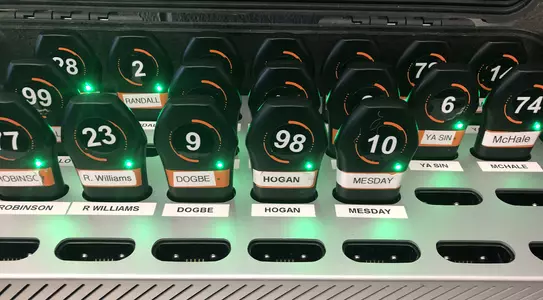
Photo by: Rich Burg
Cutting Edge Technology Enhances Temple Football Program
11.16.18 | Football
So who doesn't want to be on the cutting edge of the learning curve? Especially when it involves something that's a core part of what you're supposed to be about.
Temple football is no different. To that end, the program for the past two years has been using the Catapult System to help enhance both the safety and performance levels for its players. It's a serious investment, but one that the people tasked with utilizing this measurable data feel will only make the way the team goes about its daily operations that much more precise and efficient.
Which, of course, is a bold statement. And one that the powers that be don't make lightly.
"You're always making assessments of what's going on, what can you do better in practice or off the field (to prepare for games)," said Al Bellamy, who's in his sixth season as the Head Athletic Trainer after spending a quarter-century in the NFL, which makes him the guy with the most professional experience at his job in FBS. "The science has evolved immensely from when I started. There's so much research behind it. We have to treat the players properly, and take care of them. That's the biggest thing. The outcome of the games doesn't outweigh that.
"Injuries are going to happen. That's football. But you have to emphasize the right things. That's the way it should be. When you see (bad) things happen (at other places), it opens your eyes. It makes you really become aware of what you're doing. You re-examine everything. You become ultra-sensitive. You're dealing with concussions. You're dealing with heat in the summer. So you're always trying to educate yourself, and the student-athlete. There has to be a level of trust there. You have to work together. That's what we preach."
And the Australian-based Catapult – which first gained prominence in the European Champions Soccer League -- has allowed them to put those philosophies into practicality way more readily.
Without getting overly technical, the Catapult System relies on GPS to track over 1,000 data points per second. Which means it can provide unparalleled insights into an athlete's performance. It can quantify that information and offer the most powerful insights as to how to maximize performance. By measuring how an athlete works, with an objective viewpoint at any time, a coach can determine not only when it makes sense to make somebody work harder but – just as importantly when it comes to preventing injuries – also when it's time to cut back.
The feedback is both instantaneous and cumulative. In terms of what you can and/or can't do, the early returns suggest it's especially been helpful when it comes to soft-tissue injuries. It can show how much distance a player covers, and their overall velocity in doing so, which addresses both the locomotive and mechanical sides of the analysis. How much work have they done, and how hard have they done it? And it's right there for everyone to see, compute and adapt to. Welcome to the future.
Assistant strength and conditioning coach Ryan Horton has been at Temple for two years, or since head coach Geoff Collins arrived. The two worked together at Florida International in 2010. They both know a former colleague who got involved with the company, and long story short it soon became part of the Owls' foundation. They are not alone.
"I'm very biased, but I believe it's an unbelievable tool," Horton said. "We're entrusted with these kids' well-being. At the end of the day, you have to put that first. We're trying to reduce the likelihood of an injury for the athlete. There's so many things that can go into that. With this performance-monitoring system, we're better equipped to do that.
"I'm fascinated with it. It's become like a holy grail, especially in the summertime, when you're trying to get them ready for what's ahead. It takes a lot of the educated guesses out of the equation because we have all the information. We now know the exact physical expectations that camp will demand of our players and we can plan our summer training to prepare for it."
The device is about the shape of a beeper, although as Horton quickly acknowledges "none of our kids know what that is anymore." And it sits right behind the shoulder pads, so they don't even know they have it on. When they're not in pads, they have a fabric garment that they wear with the unit in it. And it provides instant feedback.
"I'll be up on the roof (of the football building) and I'll get a call from Coach Collins asking me about something," Horton said. "And we meet every day to go over the numbers on everybody…
"And I'm not exaggerating. There's about 1,000 different data points. The key is figuring out what you want to focus on. But I've always been one of those tech junkies. So it's right up my alley. I don't see any downside. At least not how we're applying it. And we're still learning. It's a process. We're really just getting started."
With this system, there seem to be few limitations. The staff can go back a week, a month, even a year, to check and make comparisons. Over the longer haul, those observations only figure to make for a more productive working environment for everyone.
"We're not even through two full seasons yet," Horton said. "As we get even more fine-tuned with this, we'll have a better understanding of what the sweet spot is, from a team and individual standpoint. If we did really well one week, how can we try and replicate it the next time? That all goes into it. We're blessed to have it. We strive to be on the cutting edge of how we can maximize the performance of our players, instead of just saying this is the way it's always been done.
He says it can create even more competitiveness at practice, to see who's doing what or whether that's better than the guy lining up next to them. Before, there was no way of realistically measuring those arguments. Not any longer.
"That's a huge bonus to us," Horton noted. "They get to see exactly how they did. It gets the juices flowing. Every day, we have Catapult standouts. They get recognized for who's excelling. Data is objective. Opinions are subjective. The numbers don't lie. There's no flying under the radar. You can't cheat. The truth is the truth, whether it's October or July."
"We can see if a player isn't cutting to their right as explosively as their left. Is something going on here?' We try to be proactive. At least this gives us a chance to delve a little deeper. Our message to the guys is just go. Don't worry. We'll step in if there is an issue. Let us take care of that part. To me, the injury-preventiveness side and the performance side go hand in hand."
So far, the results seem to be quite positive. Maybe it's only a matter of time before more teams on North Broad are using it too. Because the bottom line is they're all in it together, striving for the same goals. A joint effort, if you will. And to that end…
"We want to make sure we're on the same page," said Bellamy. "There's always going to be some that are harder to convince than others. Everyone wants to get out there and play. They don't want injuries to get in the way. We can't do it ourselves. That's why everyone has to have eyes on everyone.
"Before, you had to do it with your eyes. Now, you can go up and show them, 'This is what you're doing.' We have the data on every move they make. If anything's off, we can identify it. It makes it easier. It makes what you do more balanced. The last thing you want to do is put someone at risk, or make their situation worse. I think the coaches understand our role. They know, and can see. It doesn't take much to make my opinion heard.
"The message is, we care as much as (the players) do. It may not be my child. But as a professional, my job is to ensure their safety. I take that very seriously. It's what we do. Parents are more than welcome to give me a call. I want them to know (their kids are) in the best hands."
Sure sounds like a commitment worth fulfilling.
Temple football is no different. To that end, the program for the past two years has been using the Catapult System to help enhance both the safety and performance levels for its players. It's a serious investment, but one that the people tasked with utilizing this measurable data feel will only make the way the team goes about its daily operations that much more precise and efficient.
Which, of course, is a bold statement. And one that the powers that be don't make lightly.
"You're always making assessments of what's going on, what can you do better in practice or off the field (to prepare for games)," said Al Bellamy, who's in his sixth season as the Head Athletic Trainer after spending a quarter-century in the NFL, which makes him the guy with the most professional experience at his job in FBS. "The science has evolved immensely from when I started. There's so much research behind it. We have to treat the players properly, and take care of them. That's the biggest thing. The outcome of the games doesn't outweigh that.
"Injuries are going to happen. That's football. But you have to emphasize the right things. That's the way it should be. When you see (bad) things happen (at other places), it opens your eyes. It makes you really become aware of what you're doing. You re-examine everything. You become ultra-sensitive. You're dealing with concussions. You're dealing with heat in the summer. So you're always trying to educate yourself, and the student-athlete. There has to be a level of trust there. You have to work together. That's what we preach."
And the Australian-based Catapult – which first gained prominence in the European Champions Soccer League -- has allowed them to put those philosophies into practicality way more readily.
Without getting overly technical, the Catapult System relies on GPS to track over 1,000 data points per second. Which means it can provide unparalleled insights into an athlete's performance. It can quantify that information and offer the most powerful insights as to how to maximize performance. By measuring how an athlete works, with an objective viewpoint at any time, a coach can determine not only when it makes sense to make somebody work harder but – just as importantly when it comes to preventing injuries – also when it's time to cut back.
The feedback is both instantaneous and cumulative. In terms of what you can and/or can't do, the early returns suggest it's especially been helpful when it comes to soft-tissue injuries. It can show how much distance a player covers, and their overall velocity in doing so, which addresses both the locomotive and mechanical sides of the analysis. How much work have they done, and how hard have they done it? And it's right there for everyone to see, compute and adapt to. Welcome to the future.
Assistant strength and conditioning coach Ryan Horton has been at Temple for two years, or since head coach Geoff Collins arrived. The two worked together at Florida International in 2010. They both know a former colleague who got involved with the company, and long story short it soon became part of the Owls' foundation. They are not alone.
"I'm very biased, but I believe it's an unbelievable tool," Horton said. "We're entrusted with these kids' well-being. At the end of the day, you have to put that first. We're trying to reduce the likelihood of an injury for the athlete. There's so many things that can go into that. With this performance-monitoring system, we're better equipped to do that.
"I'm fascinated with it. It's become like a holy grail, especially in the summertime, when you're trying to get them ready for what's ahead. It takes a lot of the educated guesses out of the equation because we have all the information. We now know the exact physical expectations that camp will demand of our players and we can plan our summer training to prepare for it."
The device is about the shape of a beeper, although as Horton quickly acknowledges "none of our kids know what that is anymore." And it sits right behind the shoulder pads, so they don't even know they have it on. When they're not in pads, they have a fabric garment that they wear with the unit in it. And it provides instant feedback.
"I'll be up on the roof (of the football building) and I'll get a call from Coach Collins asking me about something," Horton said. "And we meet every day to go over the numbers on everybody…
"And I'm not exaggerating. There's about 1,000 different data points. The key is figuring out what you want to focus on. But I've always been one of those tech junkies. So it's right up my alley. I don't see any downside. At least not how we're applying it. And we're still learning. It's a process. We're really just getting started."
With this system, there seem to be few limitations. The staff can go back a week, a month, even a year, to check and make comparisons. Over the longer haul, those observations only figure to make for a more productive working environment for everyone.
"We're not even through two full seasons yet," Horton said. "As we get even more fine-tuned with this, we'll have a better understanding of what the sweet spot is, from a team and individual standpoint. If we did really well one week, how can we try and replicate it the next time? That all goes into it. We're blessed to have it. We strive to be on the cutting edge of how we can maximize the performance of our players, instead of just saying this is the way it's always been done.
He says it can create even more competitiveness at practice, to see who's doing what or whether that's better than the guy lining up next to them. Before, there was no way of realistically measuring those arguments. Not any longer.
"That's a huge bonus to us," Horton noted. "They get to see exactly how they did. It gets the juices flowing. Every day, we have Catapult standouts. They get recognized for who's excelling. Data is objective. Opinions are subjective. The numbers don't lie. There's no flying under the radar. You can't cheat. The truth is the truth, whether it's October or July."
"We can see if a player isn't cutting to their right as explosively as their left. Is something going on here?' We try to be proactive. At least this gives us a chance to delve a little deeper. Our message to the guys is just go. Don't worry. We'll step in if there is an issue. Let us take care of that part. To me, the injury-preventiveness side and the performance side go hand in hand."
So far, the results seem to be quite positive. Maybe it's only a matter of time before more teams on North Broad are using it too. Because the bottom line is they're all in it together, striving for the same goals. A joint effort, if you will. And to that end…
"We want to make sure we're on the same page," said Bellamy. "There's always going to be some that are harder to convince than others. Everyone wants to get out there and play. They don't want injuries to get in the way. We can't do it ourselves. That's why everyone has to have eyes on everyone.
"Before, you had to do it with your eyes. Now, you can go up and show them, 'This is what you're doing.' We have the data on every move they make. If anything's off, we can identify it. It makes it easier. It makes what you do more balanced. The last thing you want to do is put someone at risk, or make their situation worse. I think the coaches understand our role. They know, and can see. It doesn't take much to make my opinion heard.
"The message is, we care as much as (the players) do. It may not be my child. But as a professional, my job is to ensure their safety. I take that very seriously. It's what we do. Parents are more than welcome to give me a call. I want them to know (their kids are) in the best hands."
Sure sounds like a commitment worth fulfilling.

Tuesday, June 02
Saturday, May 30
Tuesday, May 19
Tuesday, May 05