Temple University Athletics
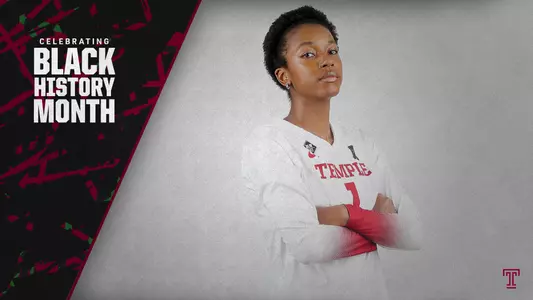
BHM21: Kayla Spells on Angela Davis
2.23.21 | Women's Volleyball
Angela Davis is many things including a civil rights leader, political activist, author, and professor. She is also a role model to many black women who grew up following her example to embrace their "blackness." Temple Volleyball Sophomore Kayla Spells explored many of the reasons that Davis has been such a key role model to her.
"She is a very enduring figure, a lot of the things, that as a black woman I want to be, she was" said Spells, "me and my sister growing up, had to often police what our blackness is, I felt like I needed to come off as approachable and unassuming, and just to see a black woman who never felt like she had to limit herself due to what other people wanted her to be, that really stood out"
Born Birmingham, Alabama on January 26th of 1944, Davis attended segregated schools all while her mother Sallye Davis was working to build unity amongst African American's in the American south.
Davis went on to be awarded a scholarship to attend Brandeis University in Massachusetts as one of only three black students in the class. Following her graduation from Brandeis, Davis obtained her masters from the University of California, San Diego and her PhD from Humboldt University in Berlin.
To this day, she continues her advocacy surrounding black feminism, prison reform and race. She has authored dozens of books with dates ranging from 1971-2021.
Spells was first introduced to Davis by a high school teacher. "I had an American studies professor my junior year, Michael Brandon, and he was very big on teaching us a lot of the history that you would not normally go over" she explained.
Davis was famously quoted saying "I am no longer accepting the things I cannot change. I am changing the thing I cannot accept." This is a quote that especially resonated with Spells as she identifies ways that she can best use her platform to address systemic racism.
It does not always have to be a grand action taken to speak to those that look up to you. Spells went on to discuss the way she wears her hair as a reason to look up to figures like Davis, "I was leaving for college and I was like, I'm going to cut it off and we are going to go natural" said Spells, "everything you can see shows that she [Davis] doesn't care what you think of her."
Spells hopes to use the example set by Davis in continuing her own activism. "There is so many different problems that we face in society today, there are problems with the whole society then there are problems that are specifically within the black community and even specifically within the black woman community" Spells explained, "we need to work together on pushing ahead on big issues, fast because that lets us get to the smaller issues that everyone might not see."
The role that a role model plays is identified by those that look up to them, and in some cases it may just require showing people that they can be unapologetically themselves, the way that Angela Davis has to Kayla Spells.

"She is a very enduring figure, a lot of the things, that as a black woman I want to be, she was" said Spells, "me and my sister growing up, had to often police what our blackness is, I felt like I needed to come off as approachable and unassuming, and just to see a black woman who never felt like she had to limit herself due to what other people wanted her to be, that really stood out"
Born Birmingham, Alabama on January 26th of 1944, Davis attended segregated schools all while her mother Sallye Davis was working to build unity amongst African American's in the American south.
Davis went on to be awarded a scholarship to attend Brandeis University in Massachusetts as one of only three black students in the class. Following her graduation from Brandeis, Davis obtained her masters from the University of California, San Diego and her PhD from Humboldt University in Berlin.
To this day, she continues her advocacy surrounding black feminism, prison reform and race. She has authored dozens of books with dates ranging from 1971-2021.
Spells was first introduced to Davis by a high school teacher. "I had an American studies professor my junior year, Michael Brandon, and he was very big on teaching us a lot of the history that you would not normally go over" she explained.
Davis was famously quoted saying "I am no longer accepting the things I cannot change. I am changing the thing I cannot accept." This is a quote that especially resonated with Spells as she identifies ways that she can best use her platform to address systemic racism.
It does not always have to be a grand action taken to speak to those that look up to you. Spells went on to discuss the way she wears her hair as a reason to look up to figures like Davis, "I was leaving for college and I was like, I'm going to cut it off and we are going to go natural" said Spells, "everything you can see shows that she [Davis] doesn't care what you think of her."
Spells hopes to use the example set by Davis in continuing her own activism. "There is so many different problems that we face in society today, there are problems with the whole society then there are problems that are specifically within the black community and even specifically within the black woman community" Spells explained, "we need to work together on pushing ahead on big issues, fast because that lets us get to the smaller issues that everyone might not see."
The role that a role model plays is identified by those that look up to them, and in some cases it may just require showing people that they can be unapologetically themselves, the way that Angela Davis has to Kayla Spells.



Players Mentioned

MB
/ Women's VolleyballTuesday, June 02
Saturday, May 30
Tuesday, May 19
Tuesday, May 05